Blog

  • Top 10 Ecommerce Website Development Companies in Jaipur

    Top 10 Ecommerce Website Development Companies in Jaipur

    In the modern world, any company, even a small one, needs to have an online presence to increase its competitiveness. 

    Your website is your business card, which will help you attract more clients, promote your products and services, and drive sales. Therefore, it is vital to choose the best ecommerce web development companies in Jaipur to build your online reputation and presence carefully.

    Below, you will find a list of the best ecommerce web development companies in Jaipur, which have been selected according to their services and overall popularity among clients. 

    Take a closer look at the most popular web development companies and choose the one that will suit your business needs the best.

    Why Choose a Website Development Company in Jaipur?

    Choosing a ecommerce web development company in Jaipur will consider your business objectives and requirements while designing an Ecommerce website development in Jaipur. They work on speed, aesthetics, and customer satisfaction to boost the revenue by driving the leads. Here are some reasons to choose a comprehensive website development company in Jaipur for your business: 

    User-Centric Structure

    It is a main factor that can attract visitors to your website. A proper layout will lead every single detail to be given attention to by the customer’s queries. An extensive website development company will build user-friendly & navigating designs with complete labeling to boost customer engagement in the business. 

    Mobile-Friendly Experience

    It is a fact that the largest proportion of total visits is made from mobile phone visits to websites. The visitor can easily leave if they don’t get a good experience. So, a leading ecommerce website development company in Jaipur includes professionals to build responsive designs for mobile users to fit all devices. Websites especially designed for mobile are easily accessible and custom-friendly to manage all operations seamlessly. 

    Greater First Impressions

    Your ecommerce website is your store window online. A tidy design increases the buyers’ trust in your brand at the Ecommerce web development company Jaipur. The pros are the ones that can envision and build layouts that speak to your organization and what you provide. It is an instant connection that connects the user and your business through the website itself.

    Enhancing Speed to Boost Conversions

    The importance of fast websites is of extreme significance in gaining your competitive edge. Even a delay of one second can be enough for users to leave the page. A good development company is made up of many practices, including speed optimization, efficient code, image compression, and server efficiency. 

    All these help boost the website’s performance. The fast websites not only have improved performance but also get more traffic that will eventually turn into clients.

    Key Services Offered by Jaipur Web Development Companies 

    Jaipur web development firms have to offer a plethora of services to businesses looking to make their presence felt in the digital arena to examine the Ecommerce website development cost in Jaipur. They not only build simple, engaging, customer-friendly sites but also additionally focus on making them scalable with web apps in the backend. 

    With performance and safety as top concerns, it will ensure that your website will undoubtedly serve you in the long run by adjusting to your evolving demands and also staying mobile-friendly.

    • Custom website development based on unique business requirements and branding.
    • E-commerce development with secured payment gateway integration.
    • CMS development for website content management and maintenance.
    • Responsive web design to make sure that the website functions seamlessly on any device.
    • Website Maintenance and Support to keep up with regular updates, maintenance, and optimization.
    • Web application development with scalable and business-oriented applications.

    Top 10 Ecommerce Website Development Companies in Jaipur (2026 List)

    Here is a list of top 10 ecommerce website development companies in Jaipur: 
    1. IMG Global Infotech

    IMG Global Infotech is a leading ecommerce web development company in Jaipur. We have a dedicated team of experts & professionals to build custom websites along with mobile apps, AI solutions & software for diverse businesses. 

    We have a track record of 520+ projects in different sectors with the same approach and positive impact on their business workflows, making us the best website development company in Jaipur. In our team, we also have AI & ML specialists to integrate the latest technologies in developed products to boost their performance and scalability. 

    With more than 11+ years of experience in this industry, our developed ecommerce websites are reliable, fast, and attractive to turn visitors into buyers in your business. 

    Key Points: 

    2. Emizen Tech

    Emizen Tech has been a well-known ecommerce web development company since 2013. They are proficient at building custom ecommerce solutions that are scalable and reliable for businesses. They have a great team of professionals with expertise in modern tech to build smarter and feature-rich solutions by emerging future technologies. 

    Key Points: 

    3. Dotsquares

    Dotsquares is an expert in building ecommerce websites for any platform. As one of the leading mobile app developers, they provide powerful and reliable apps for start-ups and established businesses in Ecommerce website development services.

    They are also best in providing custom web development solutions. Dotsquares examines the needs of each project and delivers tailor-made responses so that the client receives exactly what he wants.

    Key Points: 

    4. Dev Technosys

    Dev Technosys is an e-commerce website development business founded in 2010. They work on out-of-the-box ideas to give ideal solutions to their customers. Ecommerce website development developers develop strong & scalable e-commerce websites, which helps to increase sales & customer experience. 

    They have a huge staff of professionals who can provide professional support to design custom ecommerce solutions for different organizations.

    Key Points: 

    5. The NineHertz 

    NineHertz stands out as the choice for building e-commerce websites. The company has a team of highly experienced developers, designers, and project managers that deliver dependable applications. Such applications ensure the agility of an online business in the online marketplace.

    Key Points: 

    6. Next Big Technology

    The Next Big Technology Company is a Jaipur-based technology company that has established itself in custom ecommerce web application development and enterprise software solutions. 

    They have real expertise in backend development and database architecture and have completed some great projects for companies that needed business logic and ERP integration within their web applications.

    Key Points: 

    7. Appic Softwar

    Appic Software is a vibrant ecommerce website development company in Jaipur. The company was established in 2018, and they focus on providing innovative and results-oriented services in a wide range of fields such as AI Development, Mobile app Development, Website Development and Software Development Solutions, among others. Their mission is to assist companies in building a strong online presence.

    Key Points: 

    8. Dian Apps

    DianApps specializes in ecommerce site development. It tries to give excellent projects to its clients. The company develops unique web solutions with the help of cutting-edge technology that enables different brands to be successful.

    The company considers scalability and usability when developing web solutions, implementing such advanced technologies as artificial intelligence and augmented reality. Besides, it offers post-launch services to its clients.

    Key Points: 

    9. W3 Care Technologies

    W3 Care Technologies makes it possible to make meaningful themes and interfaces that have high interactivity to connect more effectively with the viewers. They develop high-performing e-commerce sites that capture the impression of visitors. Having an extensive variety of web development services, they develop based on the needs of the users.

    Key Points: 

    10. Octal IT Solutions

    Octal IT Solution is an IT-based online store company that has developed various projects and turned out to be a great industry leader. Octal IT Solution delivers you solutions according to your requirements and matches your brand identity. It is easy for you to reach them.

    Key Points: 

    Comparison Table of Top 10 Ecommerce Website Development Companies in Jaipur

    Company Name Founded Year Key Services Google Rating 
    IMG Global Infotech2014ecommerce development, custom website development, mobile app development, AI solutions, UI/UX design4.6
    Emizen Tech2013ecommerce development, mobile apps, web development, Salesforce, AI & IoT solutions4.2
    Dotsquares2002ecommerce development, web development, mobile apps, digital marketing, cloud solutions4.5
    Dev Technosys2010ecommerce development, web development, mobile apps, AI/ML, enterprise software4.4
    The Ninehertz 2009ecommerce websites, custom software, mobile apps, UI/UX design, web development4.1
    Next Big Technology 2009ecommerce websites, custom software, mobile apps, UI/UX design, web development4.7
    Appic Software2018ecommerce development, mobile app development, ai development4.9
    DianApps2017ecommerce development, mobile apps, web applications, product engineering, UI/UX design4.7
    W3 Care Technologies2010Magento development, Shopify development, WooCommerce, website maintenance, ecommerce solutions4.6
    Octal IT Solutions 2007ecommerce development, mobile app development, web development, AI, enterprise solutions4.1

    How to Choose the Right Website Development Partner 
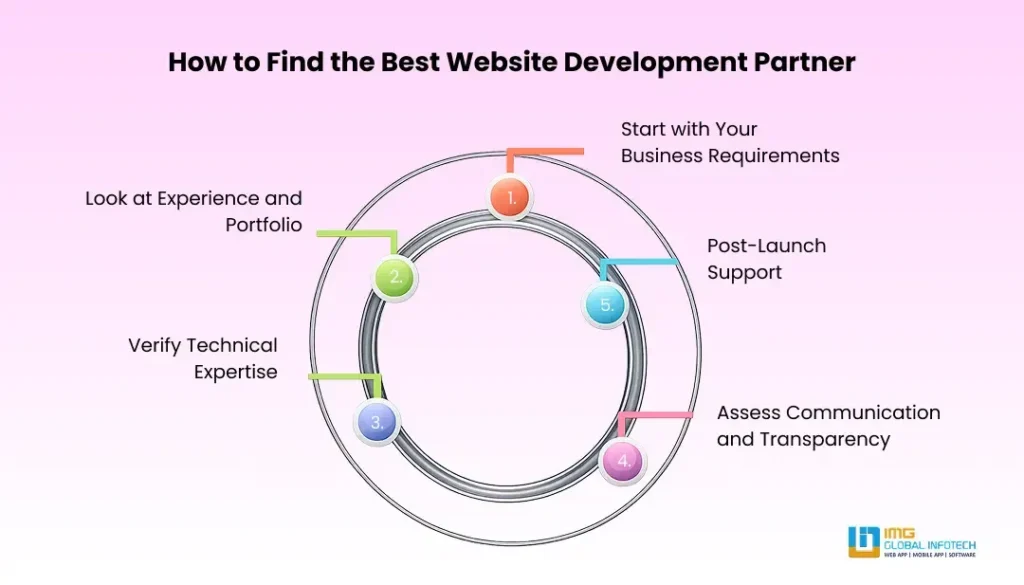
    Picking the right website development partner is kind of huge for building a high-performing, secure, and scalable digital presence that can Hire ecommerce web developers. The right team actually understands what you’re trying to do, ships quality solutions, and then stays around for long-term technical support too, not just at the start.

    Start with Your Business Requirements

    Before you even choose a partner, spell out your website goals, who it’s for (your target audience), what you’ll need, like specific features, and also where you want to scale later. When that groundwork is clear, it’s easier for the team to “get” your vision and suggest the more appropriate technology or development approach rather than guessing.

    Look at Experience and Portfolio

    Check the company’s portfolio, because it shows what they can do across different industries and website types in custom website development services in Jaipur. Seeing what they’ve built already helps you judge the design quality, technical strength, and whether they’ve done work that’s similar to your business requirements, not just random projects.

    Verify Technical Expertise

    Go for a partner who has real expertise with modern frameworks, CMS platforms, eCommerce solutions, responsive design, SEO best practices, and solid website security. When the technical knowledge is strong, your site should stay quick, flexible, scalable, and ready for whatever comes next.

    Assess Communication and Transparency

    A dependable development partner keeps communication clear throughout the whole project. They should send regular progress updates, share realistic timelines, and be upfront about costs, deliverables, and any potential risks, especially during planning all the way to deployment. No foggy explanations, no surprises.

    Post-Launch Support

    And yeah, website development doesn’t end after launch from a leading website development company in Jaipur. Choose a partner that offers ongoing maintenance, security updates, performance tuning, bug fixes, and ongoing technical support smoothly as your business keeps growing, growing, and growing.

    Conclusion

    Selecting the most appropriate ecommerce web development company in Jaipur is a critical step, as it will affect the performance of your business in an ecommerce website development company in Jaipur for startups. The web development companies listed below have diverse skills in ecommerce website development, platform-based solutions, UI/UX design, and scalable technology. 

    Before making the final selection, consider the experience of these web development companies, the quality of their past work, technical expertise, testimonials from past clients, pricing structure, and support after launching your website. With an experienced web development company, you will be able to develop a secure, high-performance, and future-oriented eCommerce website.
  • How to Build an Online Furniture Shopping App Like Pepperfry?

    How to Build an Online Furniture Shopping App Like Pepperfry?

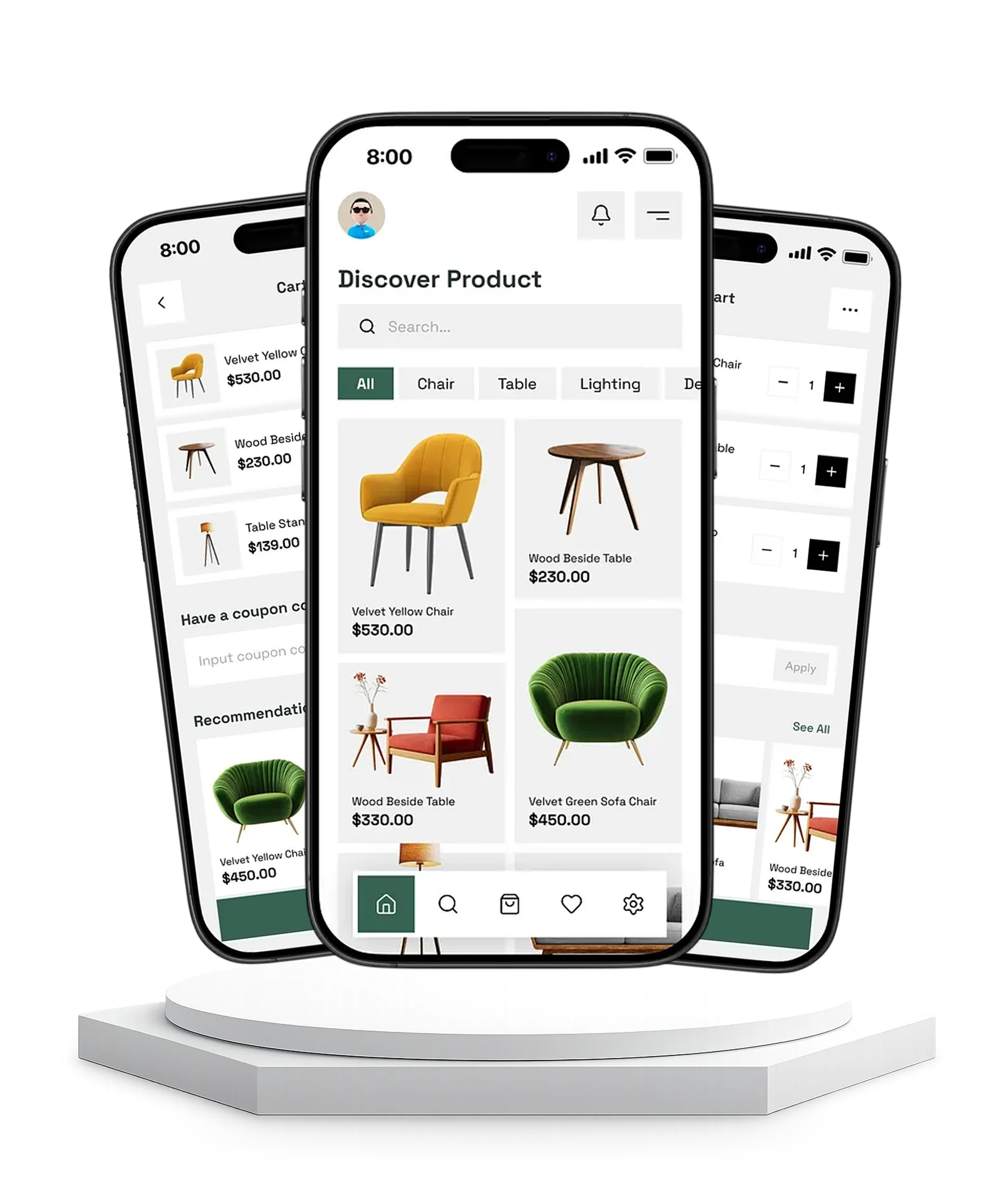
    Changes in consumer behavior and preferences have brought about growth in the home decor sector. Home decor e-commerce mobile apps such as Pepperfry have experienced an increase in income due to consumers’ willingness to shop for their home furniture and decorations online.

    Pepperfry has set new rules in the conduct of business in the sector. Despite numerous companies around the world joining the home decor e-commerce wagon, disruption is still possible in the industry.

    It is the perfect time to begin working on your mobile app development. Go through the entire article to find out how to create a furniture and home decor mobile app like Pepperfry using app development.

    What is Pepperfry?

    Pepperfry is one of India’s more prominent online marketplaces for furniture and home decor stuff, kind of. It started around 2011, by Ambareesh Murty along with Ashish Shah, and since then it has been linking buyers up with manufacturers and sellers across multiple categories. 

    You can find pretty much everything, from sofas and beds to those decor accents and modular kitchens as well, without much hassle. The thing is the platform blends classic e-commerce with an omnichannel feel by way of physical “Studio” stores, where people can actually look at products in person before they go ahead and purchase them online.

    • Founded: 2011, headquartered in Mumbai
    • Category Focus: Furniture, home decor, and furnishings
    • Unique Model: Studio stores for offline browsing + online buying
    • Target Market: Middle- to premium-segment Indian consumers

    Key Features Every Furniture Shopping App Should Include 

    Before you go on the development process, it is important to integrate major features into your furniture e-commerce app. Here is a list of core features; let’s take a closer look at them. 

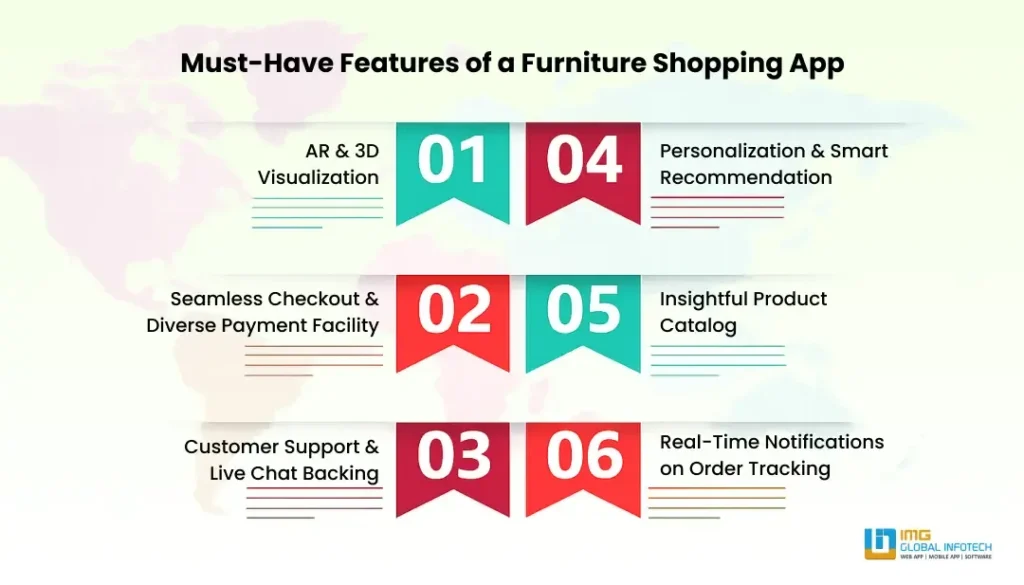
    Must-Have Features of a Furniture Shopping App 

    AR & 3D Visualization

    AR & 3D visualization can help customers to see how furniture will look in their space before purchasing. This feature can help to reduce return possibilities and enhance customer engagement in your business. 

    Seamless Checkout & Diverse Payment Facility

    A seamless and quick checkout process can increase customer retention. A furniture store app will also support multiple payment modes like credit/debit cards, mobile wallets, and BNPL services that can cater to different user preferences as well. 

    Customer Support & Live Chat Backing

    It is important to provide live chat support from AI-driven chatbots, or direct call or email support is also essential to improve customer service. A quick response to every query will improve the customer experience in your furniture store app in a positive way. 

    Personalization & Smart Recommendation 

    AI-driven recommendations will showcase personalized product suggestions based on customer preference, past purchases, and browsing history. This feature can increase user engagement, which can drive more sales in a furniture store app for the business. 

    Insightful Product Catalog

    A reliable furniture store app should also maintain an insightful product catalog that can help customers to browse products seamlessly. It should also provide categorization by type, material, price, and brand to help customers to find what they need. High-quality photographs with clear descriptions can enhance the shopping experience of customers. 

    Real-Time Notifications on Order Tracking

    The shoppers can easily track their orders in real-time to get instant notifications about the current status, shipping, and delivery in the features of a furniture shopping app. This feature can boost transparency and win customers trust in your business. 

    CTA

    How Does a Furniture App Like Pepperfry Work? 

    A furniture app similar to Pepperfry basically connects people who want to buy with makers, sellers, and their own in-house brands through a digital catalog, so the usual store markups get reduced in AI-powered furniture app development services. 

    In other words, the user just scrolls through categories, then uses filters by vibe or budget, and finally places an order online, while the platform handles delivery, does quality checks, and supports post-purchase service too. 

    A lot of these apps also mix online and offline moments, where customers can see the product, feel the texture, judge the size and finish, and then decide in furniture mobile app development. This kind of approach builds trust in a space where details matter because it’s not only about looks; it’s about how everything actually feels in real life.

    • Product Discovery: Category browsing, filters, and AR 3D previews for seeing furniture in your home more clearly, kind of like how it would really look.
    • Seller Network: A verified lineup of manufacturers and artisans, listing their products right there on the platform, so you do not have to hunt around.
    • Logistics Backbone: In-house delivery and assembly crews manage the heavy, breakable items with care and less stress overall.
    • Trust Building: Studio stores, straightforward return policies, and warranty support that actually help calm the nerves before you buy.
    • Personalization: Suggestion engines that nudge you toward products based on what you browsed and what you bought before, in a more tailored way.

    Step-by-Step Process to Build an Online Furniture Shopping App 

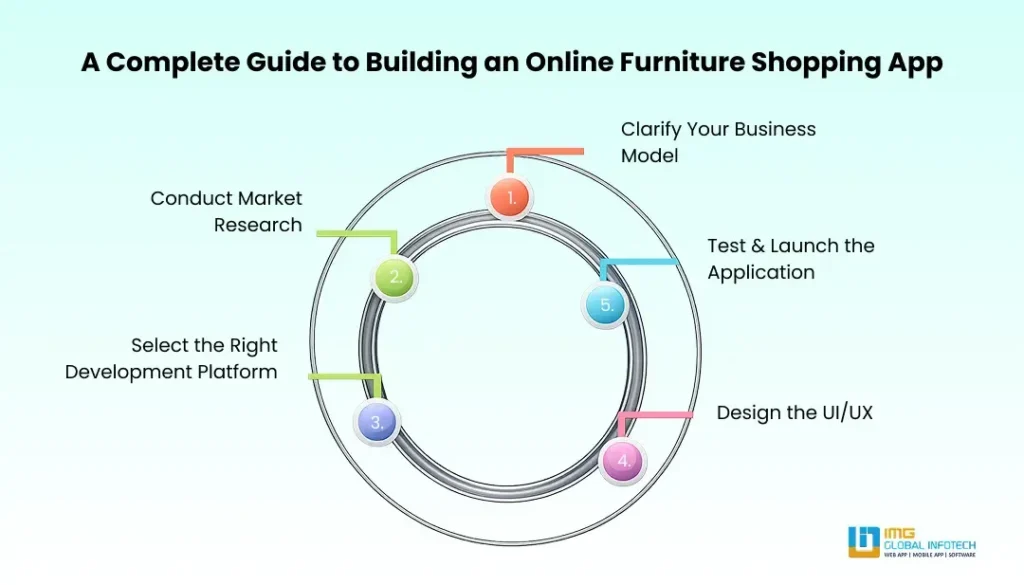
    Now it’s time to discuss the development process for furniture app development. Here is a step-by-step guide to developing a custom furniture app: 

    A Complete Guide to Building an Online Furniture Shopping App 

    Clarify Your Business Model

    Before you proceed to the development stage, it is important to make a clear vision for what type of app you will offer. Whether it would be a D2C app, e-commerce, or a multi-vendor app for a custom furniture app in the business to determine the custom ecommerce website development cost. Define the specific aspects before the next stage that would be aligned with your business needs. 

    Conduct Market Research

    A strong understanding of market trends with competitor analysis is important. 

    • What features do they offer? Are AR, AI recommendations, and 3D previews standard? 
    • How do they market their app? Do they rely on influencer marketing, paid ads, or SEO? 
    • What are customer pain points? Is slow checkout or poor search functionality a common issue? 

    For example, since more online furniture searches are kind of transaction-oriented, your app needs optimized product pages and, in general, a more intuitive buying experience to turn those searches into sales.

    Select the Right Development Platform

    As per the experts on demand mobile app development services, picking the best-suited development platform is kind of crucial in furniture ecommerce app development. So, decide whether you want to develop an Android app, an iOS app, or do cross-platform development.  

    This will help you spot what your target audience actually cares about, their interests, and preferences and basically set the cost for furniture shopping app development. After that, you can hire mobile app developers for your project.

    Design the UI/UX

    Next, create app wireframes and prototypes to show the structure, navigation sequence, and overall design of your online furniture store app. Try to stress the building of an instinctive, people-first interface, so the whole shopping journey feels smoother for your potential clients. It’s like, you want users to get what they need without thinking too hard.

    Also keep the UI and UX simple and interactive in furniture app development services. If you cram it with too many intricate options and a bunch of mixed features, it’s kind of distracting or just doesn’t grab attention. It’s better to make the experience calm, clear, and responsive, with only the important parts showing up when they’re needed.

    Test & Launch the Application

    After your furniture app development process is done, you should test and launch the mobile application carefully, like really carefully from a leading custom furniture app development company. Catching and fixing errors is a must so the business app can run smoothly, with no hiccups. Also, once you launch it on the Google Play Store or the App Store, that step largely defines the cost for furniture app development.

    Choosing the Right Tech Stack for Furniture App Development 

    Component Recommended Technology
    Frontend (Android & iOS) Flutter, React Native 
    Backend Development Node.js, & NestJS, Django 
    Database PostgreSQL, MongoDB 
    Cloud Hosting AWS, Google Cloud Platform, Microsoft Azure
    UI/UX Design Figma, Adobe XD 
    Security & AuthenticationFirebase Authentication, OAuth 2.0, JWT
    Payment Gateway Razorpay, PayPal, Stripe 
    Maps & Location Google Maps API, Mapbox
    AI & Recommendation Engine TensorFlow, AWS Personalize, OpenAI API
    Analytics & Notifications Firebase Analytics, Firebase Cloud Messaging 

    Must-Have AI Features for Modern Furniture Shopping Apps 

    Modern furniture shopping apps use AI to kind of smooth out product discovery, boost buying confidence, and build super-personalized customer journeys to Build an app like IKEA 

    or Pepperfry. These smart bits help people picture, compare, and buy furniture more accurately, while also pushing more time spent on the app and better conversions.  

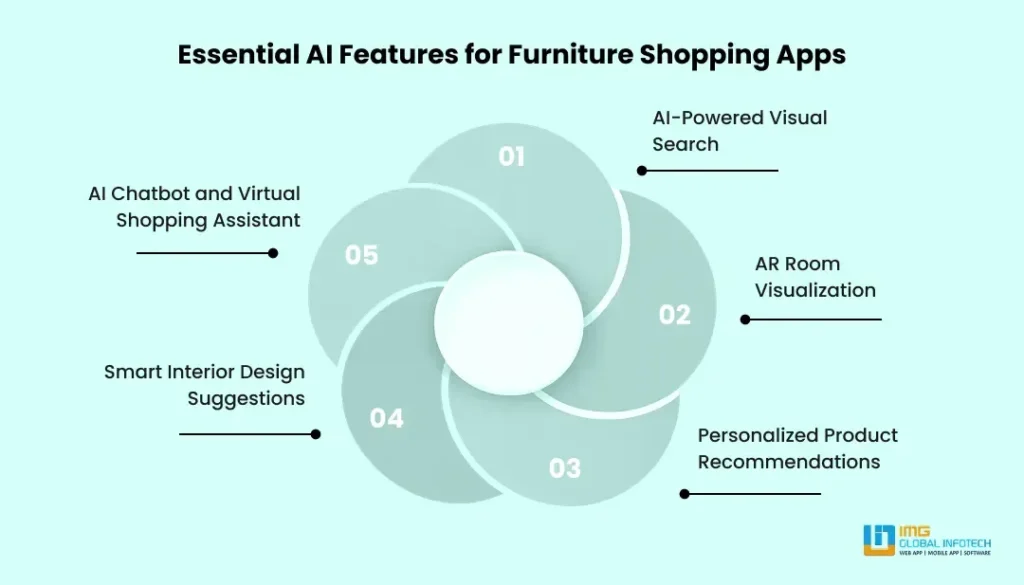
    Essential AI Features for Furniture Shopping Apps

    AI-Powered Visual Search  

    Let users upload a photo of some furniture, and then they can find similar items right away. It makes searching faster, more clever, and very tailored to each shopper, even if they aren’t exactly sure what to type.  

    AR Room Visualization  

    Give customers a way to drop furniture into their rooms using augmented reality, like so they can see how it fits and if it matches the vibe that you can hire furniture app developers. This makes it easier to judge size and style compatibility and to feel confident before paying.  

    Personalized Product Recommendations  

    You can hire dedicated ecommerce developers for browsing patterns, preferences, and shopping behavior. Then it suggests furniture that matches individual taste, budget ranges, room styles, and even buying intention in a pretty precise way.  

    Smart Interior Design Suggestions  

    Support décor planning with AI-driven ideas in online furniture app development. The app can propose complementary pieces, matching colors, workable layouts, and handy accessories, so customers can make spaces that look good and still function well.  

    AI Chatbot and Virtual Shopping Assistant  

    Provide quick help through AI chatbots from furniture marketplace app development. They can answer questions, suggest products, track orders, and keep offering personalized guidance around the clock, like a quiet assistant that never really sleeps.

    How Much Does It Cost to Build an App Like Pepperfry? 

    The average cost to build a furniture shopping app would be $5,000 to $15,000 or more. The exact cost mainly depends on various factors and the level of customization in the app development procedure. 

    App Complexity Average Cost Time Duration 
    Basic Level $5,000 to $8,000 4 to 5 Weeks 
    Mid-Level $10,000 to $15,000 5 to 8 Weeks 
    Advanced Level $15,000+ 8 to 12 Weeks 

    Why Choose IMG Global Infotech for Furniture App Development?

    Making a successful furniture app kind of depends on getting the right mix of technology, creativity, and that on-the-ground industry know-how to build an app like Pepperfry. We provide tailored solutions so your business can craft engaging, scalable, and packed-with-features furniture shopping experiences that actually feel smooth for customers.

    Custom Development

    Our developers create genuinely custom furniture applications that match your business aims, your customer preferences, and your day-to-day operational needs in furniture shopping app development services, which means you get great performance, smooth usability, and enough long-term scalability across every platform.

    AI Integration

    We also bring in advanced AI features, AR visualization, personalized suggestions, secure payment systems, and other modern tools to support intelligent furniture shopping apps that really boost user interaction and drive business growth.

    End-to-End Support

    We handle the whole lifecycle, from planning and UI/UX design to deployment, maintenance, ongoing updates, and performance tuning, so your furniture app stays protected, dependable, and ready for what comes next.

    Growth-Focused Experts

    Our specialists combine technical skill with practical market insights to build furniture apps that perform well, raise customer happiness, increase conversions, improve brand value, and support sustainable expansion over time.

    CTA

    In A Nutshell

    It would need plenty of effort and investments to get the online furniture store to the competitive level of standing in the market by a leading ecommerce development company in Jaipur. In any case, the surge in each online business due to this pandemic situation made clear that the idea of building the online furniture store is by no means a bad decision for you. Just get ready for developing home decor stores with these numerous tips and essential features. Get ready to gain various benefits in your furniture store app. 

  • How to Build a Jewellery App for Your Ecommerce Business in 2026

    How to Build a Jewellery App for Your Ecommerce Business in 2026

    The jewelry business is witnessing a major transformation towards digitization. Gone are the days when customers would depend on physical stores for buying jewelry. These days, customers carry out extensive searches for products online, browse through various designs, check out prices, go through reviews, and even make purchases online.

    With the evolution in consumer behavior from traditional brick-and-mortar shops to online platforms for purchasing, it is imperative for jewelry retailers that aim at reaching out to new audiences and generate more sales to consider getting a jewelry e-commerce platform.

    It doesn’t matter whether you are an established jewelry company or a developing retail store; setting up a presence online demands more than just setting up a website.

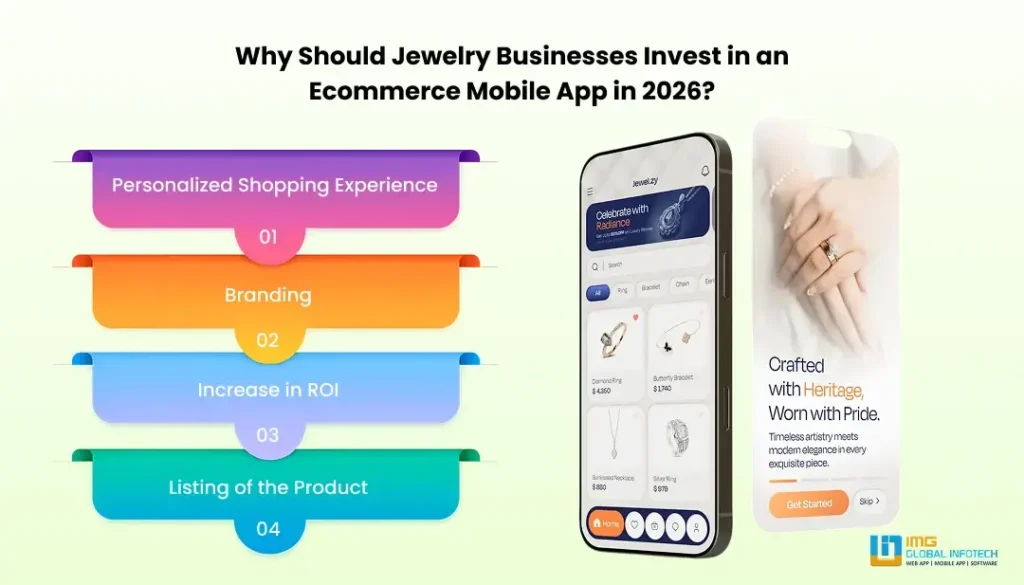
    Why Should Jewelry Businesses Invest in an Ecommerce Mobile App in 2026?

    The growing number of users shopping on online sites and mobile apps, along with the rapid pace at which this market has expanded, presents an appealing investment prospect. 

    Personalized Shopping Experience 

    Majorly, jewelry shopping apps offer a personalized experience as compared to shopping in offline stores. It will also optimize the most advanced techniques like AI and ML. Companies will also offer personalized recommendations based on user preferences and past purchases. 

    Branding

    An online jewelry business app can help to establish your brand effectively. It can also help to build a brand that can help to sell your products to keep customers in the purchasing loop without incurring any extra cost in Jewellery App Development. This can help to increase brand recognition to target a new audience for the business. 

    Increase in ROI

    Some research suggests that nearly 90% of mobile users’ online time is majorly spent using mobile apps. That’s a kind of sign that most users prefer using mobile apps over web pages on their mobile devices from a Jewellery App Development Company. Jewelry customization can play an important role in making shoppers feel connected when they purchase any product. 

    Listing of the Product

    The mobile app for your jewelry brand can be used as a catalog where you will showcase all the products and services that your business has to offer and target audiences that may find their desired pieces attractive. 

    Therefore, it would be important for you to develop mobile apps where you would be able to present the work to the client with perfectly curated, elegant, and highly efficient designs, which would give much more satisfaction to the client.

    What Features Make a Successful Jewelry eCommerce App?

    Here is a list of some core features that can help to build a reliable jewelry ecommerce app: 

    User Panel Features Jewelry Retailer FeaturesAdmin Panel Features
    Create & Manage Profile Category ManagementManage CMS
    Browse Products Price ManagementManage User Profile 
    Add to Cart Invoice ManagementTrack Jewelry Product Delivery
    Physical Store Locator Adding Certifications Review Product Pricing
    Multilingual Support Price Management Manage Categories 
    Push Notifications Discounts & Offers Product Quality Standards 
    Assistance via Live ChatManage Shop ListingManage Retailer Listings 
    Multicurrency Payment OptionsGroup Deals Generate Various Reports 

    How to Build a Jewellery App: Step-by-Step Development Process 

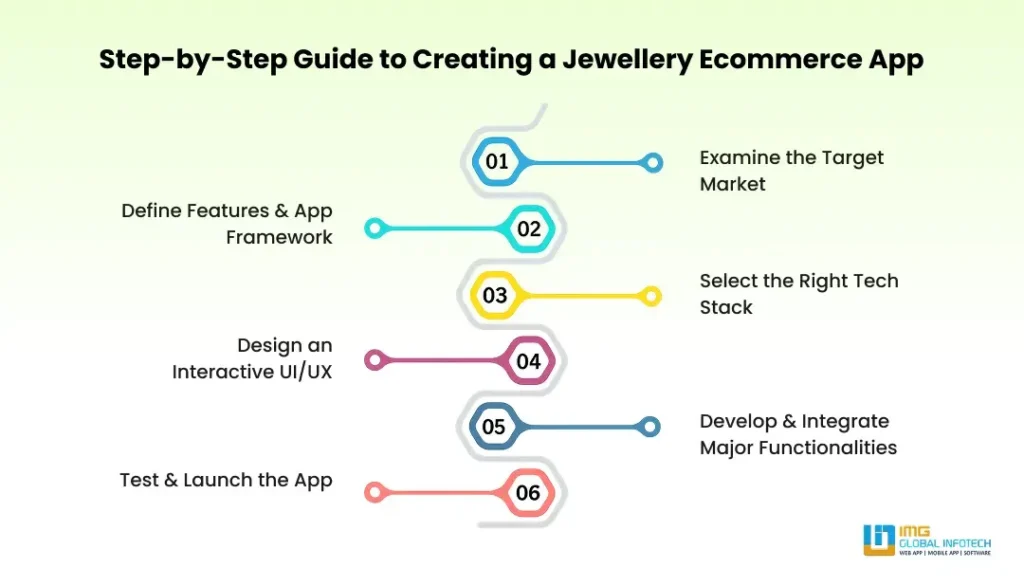
    Now let’s come to the topic we were talking about all along! Build a Jewellery App. Follow the steps and build the most user-friendly and high-performing eCommerce Jewellery App for your business:

    Examine the Target Market

    If you are planning an online jewelry shopping app, then it is important to do market research for the particular market to understand the preferences of shoppers. Through the market research before proceeding to jewelry app development, you can help to get more information about buyers’ behavior to help cultural trends. 

    Define Features & App Framework

    In this stage, it is important to outline the essential features for a custom jewelry app. It mainly includes secure checkout, multilingual support, and AR try-on in a Jewellery Shopping App. For a smooth experience, you also need to integrate features like real-time order tracking, AI recommendations, and seller dashboards. 

    Select the Right Tech Stack

    Choose a good technology Stack If you’re going to build an extensive jewelry app, pick out the most reliable frameworks, like React Native/Flutter: For cross-platform applications. Node.js: For your backend APIs. MongoDB/Firebase: For data. ARKit/ARCore: For a better AR-based try-on feature.

    Design an Interactive UI/UX

    It is important to build a navigable user interface that is visually appealing and culturally relevant. You can also hire jewelry app developers from a leading mobile app development company that can reflect positive impact to gain the interest of the audience over there. 

    Develop & Integrate Major Functionalities

    Develop an impressive jewelry application with key features such as product listings, filters, a shopping cart, a payment gateway, and social media logins in Jewellery Mobile App Development. Once this is done, integrating the AI feature for recommending user verifications will increase the efficiency of the app.

    Test & Launch the App

    Testing is an important process to check the smoothness and error-free performance along with security and localization in the app development process in Custom Jewellery App Development. After the quality assurance, the launch process begins to release the app on Google Play and the App Store. 

    Which Technologies are Best for Jewelry App Development?

    Here is the table of the technology stack that will help to build a custom jewelry app: 

    Components Technology Stack Layer
    Mobile App Development  Flutter, React Native, Kotlin 
    Frontend Framework Flutter SDK, React Native Framework 
    Backend DevelopmentNode.js, Laravel, Django 
    Database PostgreSQL, MySQL, MongoDB
    Cloud Hosting AWS, Google Cloud Platform, Microsoft Azure
    Payment Gateway Razorpay, PayPal, Stripe 
    Security Firebase Authentication, OAuth 2.0, JWT
    Push Notifications Firebase Cloud Messaging (FCM), One Signal 
    AI & Personalization Open AI API, TensorFlow, Recommendation Engine 
    Analytics & Monitoring Google Analytics, Firebase Analytics, Crashlytics

    How Much Does Jewelry App Development Cost in India?

    The average Jewellery App Development Cost would be $5,000 to $15,000 or more. The exact cost mainly depends on diverse factors and customization in the app development procedure. 

    App Complexity Average Cost Time Duration 
    Basic Level $5,000 to $8,000 4 to 5 Weeks 
    Mid-Level $8,000 to $10,000 5 to 8 Weeks 
    Advanced Level $15,000+ 8 to 12 Weeks 

    Also Read – Cost to Build Jewellery Website like Tiffany

    The latest trends in jewelry app development are completely transforming the way brands connect with customers in 2026. With the help of new-age technologies, the jewelry companies can offer their customers the ultimate experience of convenience and trust.

    AR-Based Virtual Try-On

    Augmented reality can enable customers to virtually try products like rings, necklaces, bracelets, and earrings. It can help shoppers to reduce purchasing hesitation while building an interactive and seamless online shopping experience.  

    Voice Commerce Integration

    Using a smart speaker or even your smartphone, Voice-enabled search and shopping make finding and buying things easy to determine the Jewellery website development cost. Browse a range of items, look at some design comparisons, and then finalize your order using just your voice.

    Sustainable & Ethical Shopping Features

    App for modern jewelry—eco and recycled materials Eco-conscious shoppers also have a chance—now in the mobile age, the apps of modern jewelers often focus on ethically extracted stones and metals recycled from scrap or with relevant eco and sustainability certifications.

    AI-Powered Personalized Shopping

    Customers’ browsing habits, past purchases, and even preferences are evaluated by artificial intelligence in order to show the latest trends that are most suited for your client. This in turn increases customer engagement, satisfaction, and sales.

    Blockchain for Product Authentication

    Blockchain authenticates, traces sourcing, and gives immutable proof of ownership for luxury jewelry, thereby increasing customer confidence and overall trust in a high-end luxury experience in Jewellery eCommerce App Development.

    Hyper-Personalized Loyalty Programs

    The use of advanced analytics also allows companies to design individualized rewards, offers, and membership programs based on what each customer does, ensuring they have reason to come back and making them wildly loyal.

    How to Choose the Right Jewelry App Development Company in India?

    Picking the right jewelry app development company is kind of essential if you want a secure, scalable, and feature-packed application. When you find the right technology partner, your app ends up not only delivering a really good shopping experience but also supporting future business growth in a more steady way over time.

    Industry Experience  

    You can Hire dedicated ecommerce developers that have real jewelry app development experience, plus a solid lineup of completed projects, strong technical know-how, and real familiarity with customer-oriented ecommerce solutions. You want someone who understands the little details that matter, not just the bright surface.

    Technical Expertise  

    Make sure the developers actually work with AI, AR virtual try-ons, secure payment integration, scalable architecture, cross-platform frameworks, and cloud-based application development. In other words, the technical stack should be balanced and not rushed.

    Development Process  

    Choose a team that keeps communication clear, uses an agile development approach, shares regular progress updates, ships on time, and offers dedicated post-launch technical support services. You know, the kind of support that feels responsive and not distant.

    Client Reviews  

    Look at client feedback, read case studies, check what kind of maintenance is included, and see if they provide long-term support capabilities in Custom ecommerce development. This helps confirm the partnership is reliable and that your application keeps performing consistently after launch, not only at the beginning.

    Conclusion

    In conclusion, building a reliable jewelry app is an exciting venture; honestly, it can bring both real value to users and room for business growth. Like, if you take time to really understand your audience, and then you leverage AR technology, plus you keep delivering an exceptional user experience, you can end up with a compelling platform that kind of reworks the way people shop for jewelry day to day.

    Also keep in mind success here isn’t a one-time thing; it’s more like constant tuning, staying current with technology trends and keeping that steady, unwavering commitment to user satisfaction from a Jewellery App Development Company in India. 

    So as you start your app development journey, keep your vision clear and keep your users’ needs right up front, and you’ll be well on your way to making a mark in the jewelry ecommerce market.

  • Cost to Build a Custom Fashion Ecommerce Website in 2026

    Cost to Build a Custom Fashion Ecommerce Website in 2026

    When it comes to fashion, the pace of change is at the speed of a runway flash. Fast forward to 2026, and your digital storefront isn’t just a catalogue; it’s a deeply immersive and emotional journey linking a brand’s essence to the lifestyle and aspirations of the consumer.

    So, if you’re planning your fashion website budget for a brand-new website or a complete makeover of an existing site, knowing the changing nature of costs, technology, and consumer expectations is key.

    The website in 2026 is your flagship store. This is not only your first impression but also your virtual fitting room and your brand ambassador combined in this Fashion ecommerce development guide. Dive into what you can expect to pay and what you should consider.

    Fashion Ecommerce Market Overview

    Here are some figures that can showcase the market size of Fashion ecommerce: 

    • Expected to grow to $1842.19 billion in 2030 with a CAGR of 11.8%
    • Market Trend: Revolutionizing Fashion Ecommerce with Personalized Customer Experience 
    • Growth Driver: The expansion of global internet access driving fashion ecommerce growth due to increasing social media engagement 
    • Asia pacific was the largest region in 2025 and Western Europe is the fastest-growing region in the market. 

    Essential Features of a Custom Fashion Ecommerce Website

    Before you go on the development stage, it is important to integrate the suitable features in your fashion ecommerce website. There are several benefits to integrating the important features that can help users to stay on your website longer. Here is a list of fashion ecommerce website features for your business. 
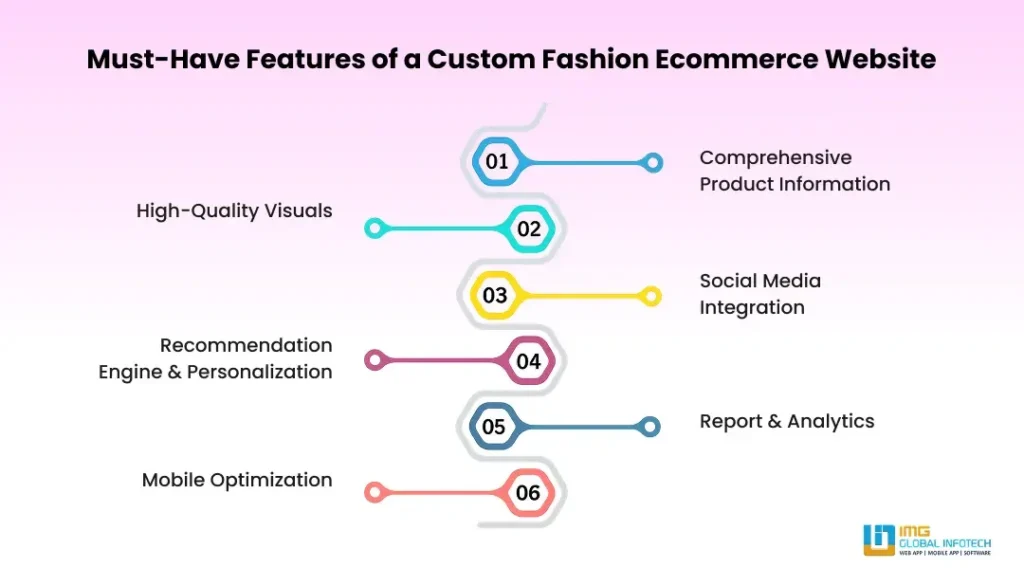
    Comprehensive Product Information

    One key thing to make sure to do is provide very specific information for each product on your website. For this particular product, recommendations for adding a detailed description, materials used, size chart, availability & care instructions. Focusing on this information will streamline the process.

    High-Quality Visuals

    You are a part of the fashion industry; therefore, you would know the emphasis placed on the visual appeal. Thus, it’s a factor you have to take into account while selecting clothing website design and development services. It typically includes making use of premium-quality product pictures to showcase the colors and texture as well as information on fashion apparel.

    Social Media Integration

    For this, social media plugins have to be implemented with sharing buttons in order for your customers to share the product with other networks. Social Media Sharing will improve your visibility and marketing in word of mouth. And so you can be guaranteed that customers would be sharing their favorite items.

    Recommendation Engine & Personalization

    Some of the efficient ways of personalizing the shopping experience are by using recommendation engines to determine the cost to build a custom fashion ecommerce website. For that, you need to make sure when you’re getting a fashion website developed, you inquire about all these options from the developer. Here you just have to use data on the purchase and viewing history of the users to give them product recommendations.
    Report & Analytics

    The other essential thing would be the integration of analytic tools into your website. These kinds of tools are recognized for being able to gather information that will give insights about the sources of traffic, customers’ behavior, and conversion rates in custom ecommerce development. It is important that you analyze this kind of information to be able to understand the preferences of your clients.
    Mobile Optimization

    These days, a lot more consumers use their mobile devices to shop online. Thus, there comes a need for you to ensure that your fashion e-commerce website caters to mobile users. One way to do that would be ensuring that your website is mobile responsive.

    The benefit of having a mobile responsive website is that it helps provide customers with a seamless and intuitive experience across different devices. Here, you need to consider the aspects that are unique to the mobile device.

    Fashion Ecommerce Website Development Cost Breakdown

    The average custom fashion ecommerce website cost would be $5,000 to $15,000 or more. The exact cost mainly depends on diverse factors and the level of the customization in the website development process. 

    App Complexity Average Cost Time Duration 
    Basic Level $5,000 to $8,000 4 to 5 Weeks 
    Moderate Level $10,000 to $15,000 5 to 8 Weeks 
    Advanced Level $15,000+ 8 to 12 Weeks 

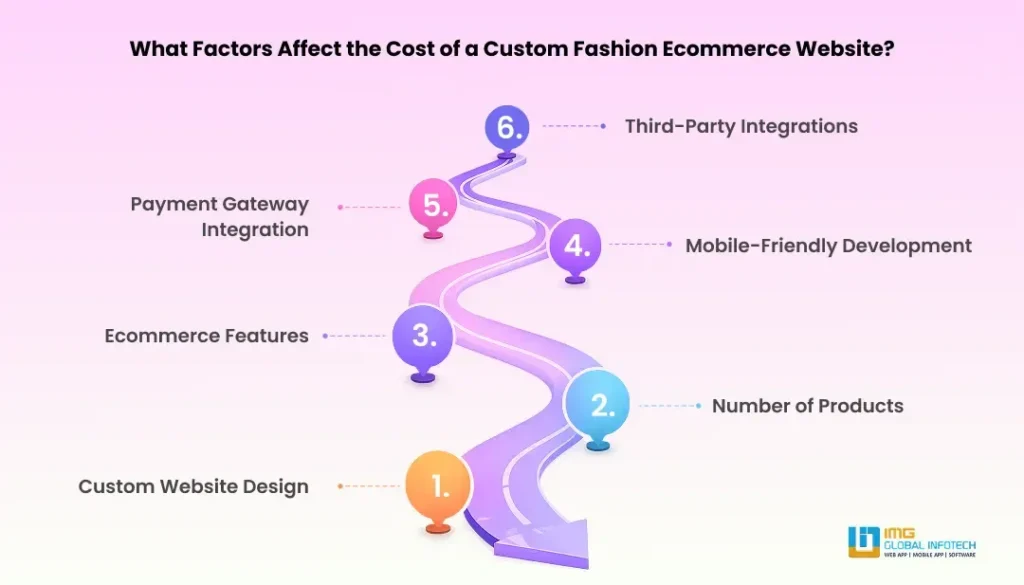
    Which Factors Influence the Cost of a Custom Fashion Ecommerce Website?

    Here are several factors that can influence the fashion ecommerce website development cost: 

    Custom Website Design

    An interactive design aligned with your brand identity to increase customer trust to improve conversions to determine the fashion ecommerce development cost. The custom design majorly costs more than pre-built templates as well. 

    Number of Products

    As your catalog keeps getting larger, more work gets piled up for organizing products, setting up categories and filters, and doing inventory management—kind of a never-ending rhythm to examine the custom ecommerce website development cost. It’s like there’s more to manage at every turn, and the whole thing needs careful upkeep.

    Ecommerce Features

    The advanced functionality can increase the ecommerce website development by including features: 

    • Product Variants 
    • Customer Reviews 
    • Order Tracking 
    • Inventory Management 
    • Secure Checkout 
    • Coupon Management

    Mobile-Friendly Development

    More than 70% of online shoppers browse using smartphones. A responsive website makes sure the shopping journey feels seamless across all devices, like it stays in sync even when you switch from phone to tablet.

    Payment Gateway Integration

    Secure payment methods like UPI , cards, Net Banking, digital wallets, and Buy Now Pay Later actually make customers feel more certain and less hesitant, which then tends to lift sales.

    Third-Party Integrations

    When you integrate with shipping providers, CRM software, and WhatsApp, plus analytics, email marketing, and inventory systems, it can quietly mess with a Fashion Ecommerce Website, like not in one clean way but in a bit of a stitched-together manner.

    Real-Word Example for Custom Fashion Ecommerce Website Development 

    Leading fashion brands often rely on custom ecommerce solutions in order to deliver more personalized shopping experiences, smoother performance, and easily scalable operations in custom ecommerce development. In these real-world examples it becomes clear how tailored development really helps a business boost customer engagement and sustain long-term growth, sort of, you know.

    Zara

    Zara kind of delivers a seamless custom fashion e-commerce experience powered by AI recommendations, quick inventory refreshes, omnichannel shopping, and a mobile-first design. 

    Its tech helps with personal browsing, faster product launches, and more efficient order handling, so you get a highly responsive and customer-focused online fashion platform, which feels kind of immediate even if the needs shift.

    Read More – How to Build a Fashion Ecommerce App Like Zara

    ASOS

    ASOS comes with a feature-rich fashion ecommerce setup that feels pretty personalized, with product suggestions tailored to you, plus advanced search filters you can actually use to determine the fashion ecommerce website pricing. There is also virtual styling inspiration, and they back global shipping. 

    The scalable architecture and a user-friendly interface help keep customers engaged while it efficiently juggles millions of products along with international shoppers, so everything runs smoothly even when demand spikes.

    Read More – Build a Fashion Ecommerce App Like ASOS

    Boohoo

    Boohoo kind of leverages a high-performance e-commerce platform to show off fast fashion collections and then kind of uses personalized recommendations too in Fashion ecommerce development guide . It includes real-time inventory management, secure payments, and mobile optimization, so the whole thing feels smooth even when customers are on the move. 

    With this flexible development approach, they can push out frequent product updates and also run promotional campaigns, all while keeping the shopping experience seamless for customers who are trend-conscious.

    FabIndia

    FabIndia sort of brings traditional craftwork together with more modern e-commerce technology by doing things like personalized product discovery, secure transactions, and multilingual support. It also has responsive design, so pages adjust right on the fly, which makes the whole thing feel kind of seamless. 

    The custom fashion platform showcases handcrafted collections but still manages to give you that smooth shopping experience on both web and mobile.

    Why Choose IMG Global Infotech for Fashion Ecommerce Web Development?

    We build fashion e-commerce websites that kind of blend attractive design with smooth functionality and, yeah, scalable architecture so your company can grow for the long term from Ecommerce web development in india. Our group usually concentrates on making shoppers stay interested, and that usually helps brands boost conversions, keep customer happiness, and improve their online presence a lot.

    Custom Fashion Store Development

    We craft a tailored fashion storefront, focused on what you want to achieve, how your product catalog is organized, and what your customers expect. Our developers make sure every component fits your brand personality and also your expansion strategy, even when things get a little complex.

    User-Centric UI/UX Design

    Our team designs a visually pleasing, mobile-first, and intuitive shopping experience… the kind that keeps people around. We care about smooth navigation, quicker product discovery, and a simplified checkout flow to improve those conversions. Also, we try to reduce friction in the little steps that matter, period.

    Advanced Technology Expertise

    Our experts lean on modern technologies, frameworks, and ecommerce best practices to create secure, scalable, high-performing fashion websites. We also ensure the platform stays dependable as your business grows.

    Seamless Third-Party Integrations 

    We connect secure payment gateways, shipping providers, CRM platforms, inventory management, and marketing tools in fashion ecommerce website development. Our developers make sure each connection works together smoothly for efficient everyday business flow and for customer convenience too. 

    SEO and Performance Optimization 

    Our team builds websites using an SEO friendly structure, improves the loading speed, and keeps the experience responsive on every screen from a scalable Ecommerce development company in jaipur. We help your fashion store pull in natural traffic while also keeping the entire checkout and browsing experience smooth and easy. 

    Ongoing Support & Future Scalability 

    After launch we stay on it with routine upkeep, feature upgrades, performance monitoring, and technical support when needed. Our experts ensure your fashion ecommerce website stays current, protected, and ready for what comes next, not just today.

    Closing Remarks

    Creating a fashion website by means of fashion eCommerce web development involves numerous steps starting from the selection of features to building a proper technology stack. 

    When working with either web design agencies or a leading Ecommerce development company in jaipur, do not forget about placing user experience and performance at the top of your list to become successful in the field of the fashion business. Knowing the costs and technologies will help you to build the website, which will be both aesthetically pleasing and profitable.

  • AI Agents in Fintech: 7 Future Trends That Will Transform the Finance Industry

    AI Agents in Fintech: 7 Future Trends That Will Transform the Finance Industry

    Fintech is being transformed fast by AI agents capable of making decisions automatically, carrying out smart automation, and offering very personalized financial services. These AI-driven systems are actively working alongside human staff at banks and other financial institutions to help with everything from catching fraud and making trades based on formulas to responding to customers and evaluating risks. They are opening doors for improved efficiencies, cutting down operational costs, and providing much better experiences for users.

    As advanced AI technologies get integrated with the global fintech industry, intelligent agents will be at the forefront of the driving forces behind the new generation of banking, lending, wealth management, and payment solutions. This blog will take a look at seven fintech trends for 2026, illustrating how AI agents are changing the finance industry, opening up new opportunities for businesses, and why investing in AI-powered fintech solutions is becoming a strategic move for companies that want to be competitive in the digital economy. 

    What Are AI Agents in Fintech?

    Fintech AI agents are smart software that, through the use of artificial intelligence in performing their tasks, require only a minimal amount of human intervention. For one, they examine the gathered information, automate the different steps, recognize fraud, evaluate risks, tailor financial advice, carry out trades, and provide help to customers. Through these, the role of artificial intelligence in fintech aids financial companies in improving the work process, precision, safety, and decision-making within the framework of various financial services.

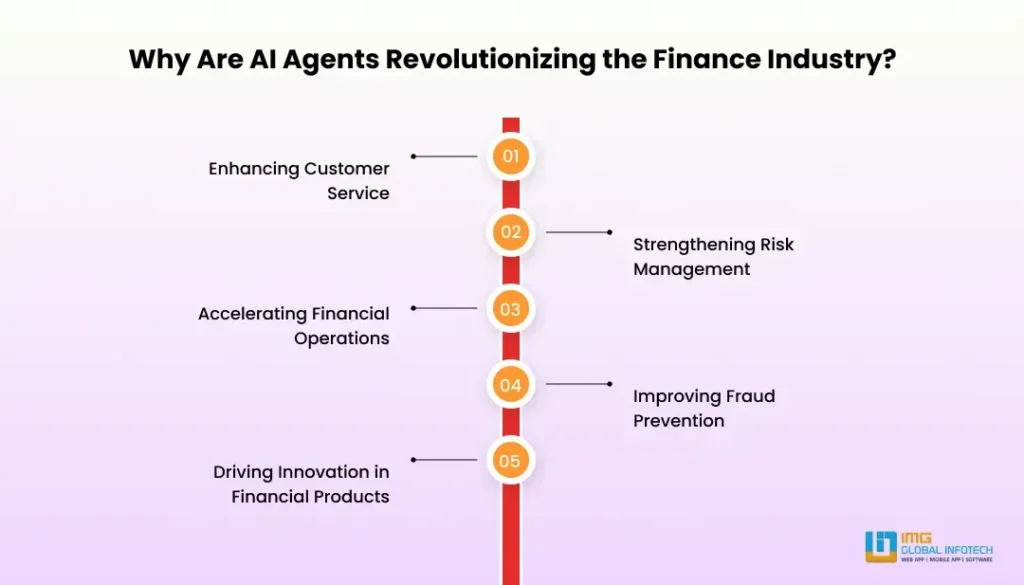
    Why Are AI Agents Transforming the Finance Industry?

    The ability of AI agents to automate processes, change decision-making, and make delivery of personalized services has started a revolution in the finance industry. They provide a steady source of driving force for innovation, efficiency, and gaining competitive advantages in today’s financial ecosystems.

    1. Enhancing Customer Service

    AI agents, financial institutions, and customers benefit from round-the-clock customer service at the same time through the use of smart chatbots and virtual assistants. They answer questions, provide financial advice, and customize the dialogs, which, on one side, enhances customer delight and, on the other side, helps banks in lowering the time to respond and the costs linked to running a business.

    2. Strengthening Risk Management

    Using numerous financial data, AI agents are able to figure out potential risks, qualify clients for loans, and estimate the stock market’s behavior. Fintech aims at forecasting features; financial firms can make prudent decisions, limit their exposure to financial losses, and strengthen their business continuity.

    3. Accelerating Financial Operations

    AI agents speed up operations to a large extent by digitalizing loan evaluations, payment processing, document checking, and compliance tracking, among others. Not only do they raise the level of efficiency, but they also decrease errors caused by humans and give organizations the capability to serve customers with delivery speed at its highest point.

    4. Improving Fraud Prevention

    AI in finance are constantly looking at transactions and how people behave to spot unusual things and suspicious activities as they happen. Their ability to learn and change helps to stop financial fraud, make cybersecurity stronger, and protect institutions as well as customers from the threats that keep changing.

    5. Driving Innovation in Financial Products

    With AI agents, fintech can create smart financial products, such as robo-advisors, automated investment platforms, and personalized lending solutions, to name a few. These new products not only open up different ways of making money but also cater to the needs of customers in the digital finance world, whose expectations are always increasing.

    In the coming years, fintech will be mainly powered by AI agents that are not only capable of making decisions independently but also continuously enhancing financial services and security. It is these trends that will shape the very nature of how financial institutions operate and how they serve their customers.

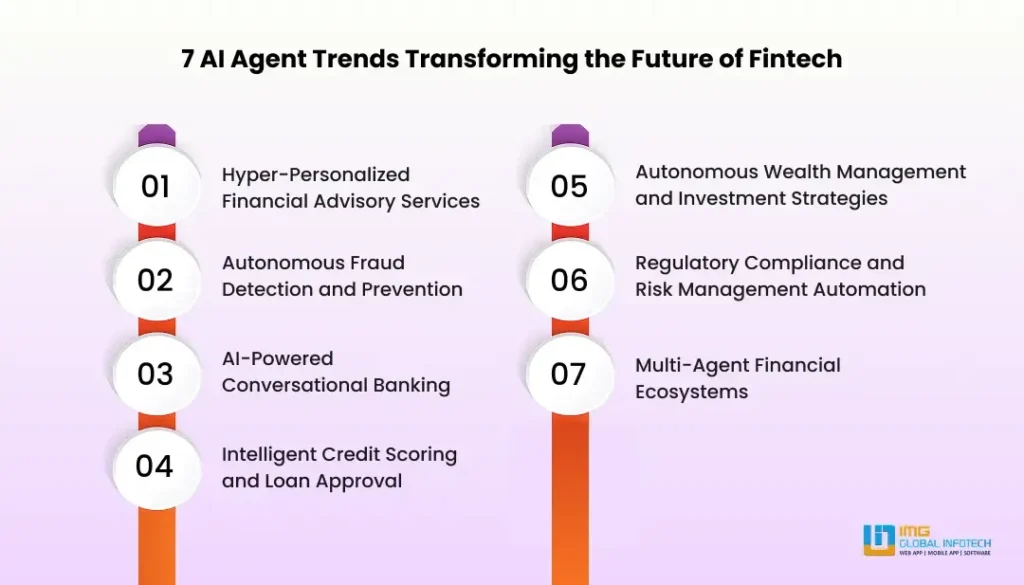
    1. Hyper-Personalized Financial Advisory Services

    AI agents will take a customer’s income, spending, financial objectives, and environmental conditions together to provide very tailored financial advice. Besides, real-time guidance for savings, investments, insurance, and budgeting will not only benefit financial planning but also create more delightful customer experiences.

    2. Autonomous Fraud Detection and Prevention

    In the future, AI in finance will be able to identify suspicious transactions even before they happen, detect new kinds of fraud, and take immediate action without anyone having to intervene. As they keep on learning from the different cyber threats that are always changing, they will be able to make financial security even stronger, reduce losses, and increase trust in digital banking and payment platforms.

    3. AI-Powered Conversational Banking

    With the help of advanced AI agents, it would be possible to have natural and human-like conversations over banking channels. Fintech technology trends will be able to take care of complicated customer enquiries, help with finances, carry out transactions, and give multilingual support, resulting in quicker, more personalized, and smoother banking experiences anytime.

    4. Intelligent Credit Scoring and Loan Approval

    Using alternative data sources, behavioral analytics, and real-time financial information, AI in banking will determine creditworthiness. This will lead to faster loan approvals, more accurate lending, fewer defaults, and provide financial services to more people, including those who are underserved individuals and small businesses.

    5. Autonomous Wealth Management and Investment Strategies

    AI  agent development company will keep itself updated about the market situation at all times, adjust investment portfolios, rebalance assets, and carry out data-driven trading strategies. These smart systems will enable investors to get the most out of their returns while limiting their risks through automated and tailor-made wealth management services.

    6. Regulatory Compliance and Risk Management Automation

    AI agents can also help to automate compliance monitoring by keeping an eye on regulatory changes, spotting policy breaches, and producing audit-ready reports. Their ability to forecast will enable financial institutions to control operational risks, stay compliant, and cut down on expenses related to regulatory procedures.

    7. Multi-Agent Financial Ecosystems

    Several AI agents will work together in banking, insurance, investment, and payment systems to automate the entire financial operations from start to finish. These interlinked ecosystems will not only facilitate data sharing and smooth out workflows but will also improve decision-making and create very efficient digital financial services.

    Key Benefits of AI Agents in Fintech

    AI agents are changing the game for financial technology firms in a number of ways. First, through greater efficiencies in operations; second, by delivering better customer experiences; third, through increased security; and fourth, by helping to make more intelligent decisions. Below are the major benefits leading to a comprehensive adoption of AI.

    1. Faster Financial Decision-Making

    AI agents are capable of sifting through enormous amounts of financial data continuously and simultaneously analyzing for meaningful insights that organizations may act on. Consequently, they allow organizations to make decision making processes more quick and precise, especially in areas like credit, investments, risk, and customer service. They also lessen dependence on delays and human errors.

    2. Enhanced Customer Experience

    Their hugely successful features have been the accurate identification of financial needs and 24/7 provision of instant help through a digital, interactive, and smooth experience at any time.

    3. Improved Fraud Detection

    AI-driven finance can spot fraud or any non-compliant activities on financial transactions as they keep monitoring them. Apart from detecting fraud at an early stage, it reduces losses and easily provides remedies to deal with cybersecurity, thus safeguarding customers’ sensitive data and improving their reliance on digital financial services.

    4. Reduced Operational Costs

    AI agents can free human resources from boring and repetitive clerical duties such as document verification, payment processing, compliance, and customer service. Thus, workers are relieved of being overburdened, which results in fewer errors, higher productivity, and better overall business efficiency.

    5. Better Regulatory Compliance

    AI agents enhance compliance work by continuously monitoring regulatory standards, transaction monitoring, report generation, and identification of potential violators. As a result, these initiatives allow financial institutions to lessen compliance risks a,securing against penalties, and maintaining thorough records with minimum manual effort.

    6. Scalable Financial Operations

    AI agents can very easily ramp up their activity levels to deal with increased numbers of transactions, customer inquiries and financial data without necessarily requiring employees to increase in a directly proportional manner. Due to their scalability, these agents enable fintech companies to make room for growth while still both maintaining high quality of service and being operationally efficient.

    7. Competitive Business Advantage

    Making use of AI agents, organizations are able to create a product differentiation strategy that reflects a competitive edge through rapid product innovation, providing customer-specific financial solutions, intelligent operational automation, and utilizing data-driven decision-making for a whole four-way effect. Ultimately, such factors help enterprises to generate more revenue, successfully transform in tune with the market, and meet changing customer demands.

    Challenges of Implementing AI Agents in Fintech

    Even though AI provides significant opportunities for the sector, the introduction of AI into fintech faces issues and challenges of technology, management, and compliance. Without the solutions of these problems, it is impossible to make AI-driven financial services that are secure, scalable and reliable.

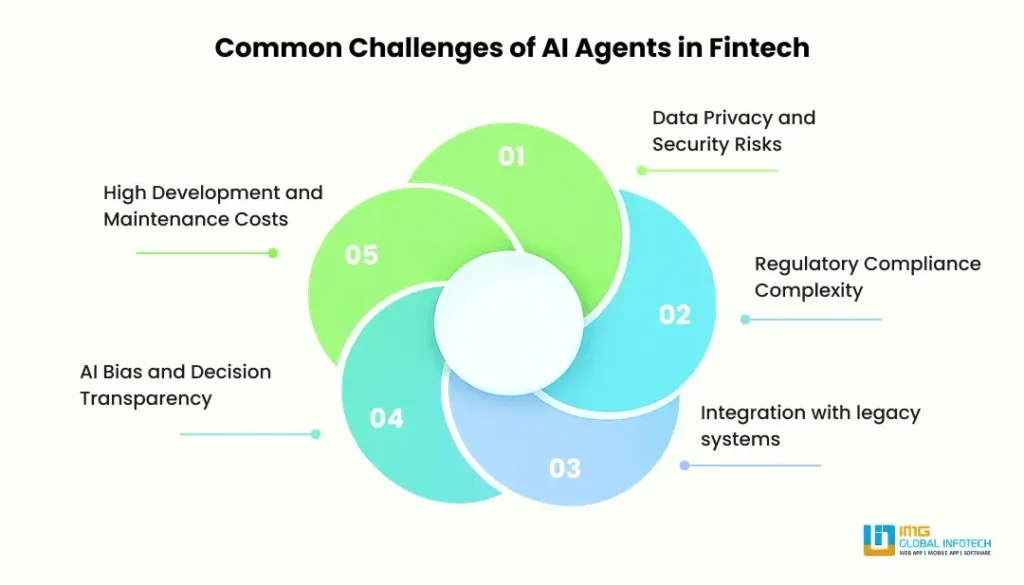
    1. Data Privacy and Security Risks

    AI agents process large amounts of sensitive financial and personal data, securing this information is a critical factor in the success of their operations. It is the company’s responsibility to implement very rigorous security measures such as the use of encryption techniques and restriction of access, among others, in order to prevent unauthorized disclosure of data and maintain trust of customers.

    2. Regulatory Compliance Complexity

    Financial laws change from one country to another and are updated from time to time. Ensuring that AI agents comply with law amendments, industry standards, and code of conduct will require close monitoring, thorough updating, and establishing a well-structured governance framework.

    3. Integration with legacy systems

    There are still a lot of banks and other financial institutions that have legacy systems that are not compatible with AI technologies. Besides other challenges, aligning such integration efforts with planning and other modernization strategies, connecting AI agents with old systems, might be complex, need a lot of time and effort, and be very expensive.

    4. AI Bias and Decision Transparency

    If the training datasets are incomplete or unbalanced, then AI agents may come up with biased decisions. Hence, financial institutions should be transparent about, explain, and ensure fairness in their AI-driven decisions so as to keep customer trust and also meet ethical standards.

    5. High Development and Maintenance Costs

    Installing financial aid solutions is a costly affair, as apart from the requirement of highly skilled personnel, infrastructure, training data, and model optimization are also to be considered. Due diligence, along with a comprehensive view of the business implementation costs, the expected business value, and return on investment, should be a part of the consideration process of organizations.

    Future Outlook: What Will Fintech Look Like by 2030?

    By 2030, AI agents will be the main drivers of the fintech revolution, facilitating the execution of financial operations without human intervention, the provision of services tailored to the individual, decision-making powered by intelligence, and changing the ways in which business and consumers conduct financial activities.

    1. Autonomous Financial Institutions

    Banks and other financial institutions will be delegating a larger amount of their core operations management to AI agents such as customer interaction, credit granting, clearing, identifying wrongdoing, investment management, etc. Fully automated workflow systems will be enabling the most efficient processing of tasks, cost minimization, and the emergence of the quickest financial decision-making method with minimum human intervention.

    2. Personalized Finance at Scale

    AI-powered financial services will be able to deliver extremely personalized financial products and services by monitoring customers’ live behaviors, preferences, and goals. Intelligent financial platforms will offer customers personalized investment suggestions, borrowing opportunities, insurance options, and financial management methods, among other services.

    3. AI-Driven Regulatory Compliance

    Compliance will be more dynamic, and this is possible with AI agents for banking that regularly examine rules, identify breaches, and produce reports ready for an audit. Such smart automation would assist financial bodies in decreasing the expenses of compliance while at the same time raising the level of transparency, governance, and risk management through their operation.

    4. Seamless Multi-Agent Financial Ecosystems

    The AI-powered agents interact with the banks, insurers, payment providers, investment firms, and fintech platforms to automate the whole range of financial services without human intervention. Such ecosystems will make possible the implementation of faster payment instructions, superior data distribution, and elevated levels of service and experience for customers across the financial world.

    5. Smarter and More Secure Digital Finance

    What is more, by 2030, fintech innovation will integrate deep analytics, foresight intelligence, and instantaneous risk identification to establish extremely safe digital financial settings. Banks and other financial service providers will, combined and thoroughly with AI, support quicker service delivery, higher security, and better decision-making accuracy, as well as rapid adjustment to market changes.

    Conclusion

    AI agents can play a role in shaping a new era of financial technology. These roles include but are not limited to enabling the intelligent use of automation, offering customized financial services, increasing security, and fostering data-driven decision-making. With financial institutions deeply involved in the adoption of financial services automation, investments in solutions that are scalable and ready for the future will be a matter of survival for those aiming at maintaining a competitive advantage. IMG Global Infotech is an AI agent development company that focuses on the design of highly customized AI-driven fintech solutions that fit the needs of today’s businesses. We assist businesses in developing secure, innovative, and efficient financial applications by using intelligent banking platforms and fraud detection systems, as well as AI-powered wealth management and compliance automation. Work with IMG Global Infotech to turn your fintech dream into a strong AI-powered reality.

  • How Much Does It Cost to Build a Mobile App in India for Startups?

    How Much Does It Cost to Build a Mobile App in India for Startups?

    In 2026, the mobile applications have become not just technological gadgets—they have turned into the new epicenter of business functioning, growth, and interaction in a highly digital environment in India. 

    Regardless of whether you are only defining your startup on a local scale, scaling your D2C brand or simply going digital for the first time in your life, the necessity for mobile apps remains higher than ever before. Ultimately bringing you to that one crucial question: what is the highest cost of mobile app development in India?

    Let us take a closer look at the answer. Not in the form of complicated technical definitions and broken-down lists, but rather an understandable everyday context. From the average prices in the market to some disruptive elements that gradually increase or decrease your budget, here is everything you should know.

    As per the record of Grand View Research, The mobile app development market in India is expected to reach a projected revenue of $48,270.9 million by 2033 with a CAGR of 18.5% from 2026 to 2033. 

    India Mobile App Market Highlights: 

    • The India mobile application market generated a revenue of $12,658.2 million in 2025 and is expected to reach $48,270.9 million by 2033.
    • The India market is expected to grow at a CAGR of 18.5% from 2026 to 2033.
    • In terms of segment, gaming was the largest revenue-generating application in 2025.
    • Gaming is the most lucrative application segment registering the fastest growth during the forecast period.

    Why India Is a Leading Hub for Mobile App Development

    India has turned into a go-to place for mobile app development, sort of, by blending solid technical know-how, cost efficiency, and a steady sense of innovation in mobile apps development cost in india. Companies around the globe pick Indian development squads so they can ship scalable, secure, packed-with-applications solutions across different industries, not just one.

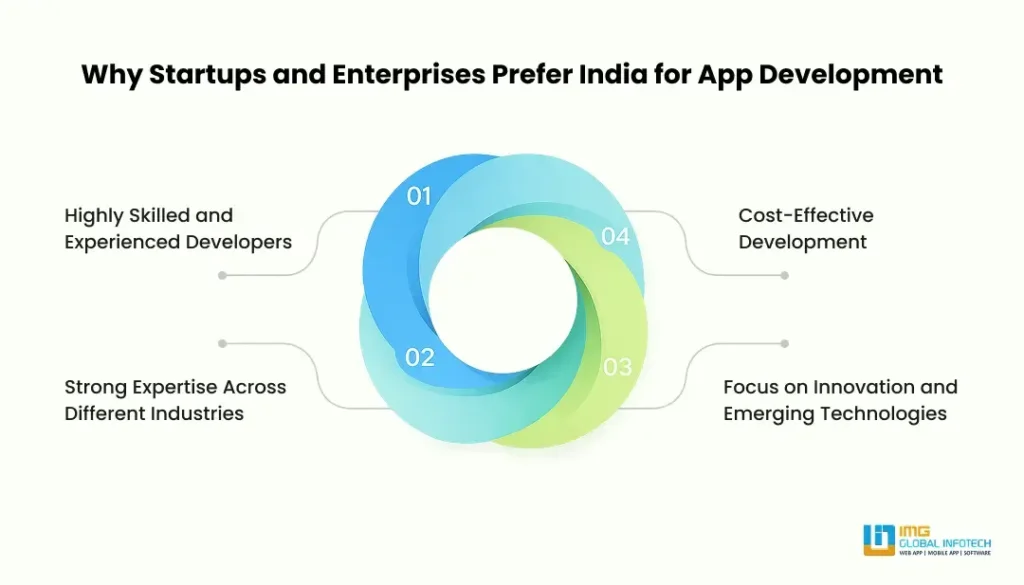
    Why Startups and Enterprises Prefer India for App Development

    Highly Skilled and Experienced Developers

    India really has a big pool of skilled mobile app developers who work with modern tech and practical delivery. They bring knowledge in cross-platform frameworks, AI integration, cloud solutions, and enterprise-grade applications. So, businesses get digital products that feel fresh, grow well over time, and stay high quality.

    Cost-Effective Development

    Many businesses get an advantage from competitive development pricing while still getting top-tier application quality in app development cost in india. You also tend to see agile development rhythms, consistent communication, and attentive project management. In the end this helps maximize return on investment, and it can also push product launches faster than expected.

    Strong Expertise Across Different Industries

    Developers here have built mobile apps for healthcare, fintech, eCommerce, education, logistics, real estate, and on-demand services to determine the cost to build a mobile app in india. That means businesses can request tailored solutions, built around industry rules, plus real customer expectations, not generic templates.

    Focus on Innovation and Emerging Technologies

    The app development ecosystem in India seems to adopt new ideas quickly. Things like AI, IoT, blockchain, AR/VR, cloud computing, and automation are often used to create future-ready mobile applications. Those advanced features can improve user engagement and support long-term more reliably.

    CTA

    The Real Cost of Building a Mobile App in India

    The average cost to build a mobile app in India would be $5,000 to $15,000 or more. The real cost will be finalized on diverse factors like UI/UX, frontend & backend development, API integration, AI technologies, and maintenance along with customization in the mobile app development process. 

    App Complexity Average Cost Time Duration 
    Basic Level $5,000 to $8,000 4 to 5 Weeks 
    Mid-Level $10,000 to $15,000 5 to 8 Weeks 
    Advanced Level $15,000+ 8 to 12 Weeks 

    How Long Does It Take to Build a Mobile App?

    Building a mobile app usually takes something like 4 to 12 weeks, though it kinda depends on complexity, those features you want, the design requirements, and the development approach. If it’s a simple app with basic functionality, it can be wrapped up within a couple of weeks to examine the mobile app development pricing. But if you’re going for feature-heavy solutions, advanced integrations, real-time capabilities, and custom user experiences, it generally stretches into a longer development cycle.

    Most of the time the work goes through planning, UI/UX design, development, testing, deployment, and then post-launch optimization in app development cost for startups. And sure, the schedule can swing based on platform choice, third-party integrations, security requirements, and even feature revisions that come late in the process

    Having an experienced development team in your corner tends to make everything smoother, keep quality steady, and deliver a scalable application without wasting too much time overall.

    Mobile App Development Cost in India vs Other Countries

    Mobile app development demands selecting a good mobile app development company in India, which greatly influences the quality of work, time schedule, and cost of the project to examine the custom mobile app development cost. The cost of mobile app development in India, the United Kingdom, and the United States can be compared for the most cost-effective solution for you.

    Countries Average Cost Time Duration 
    India $5,000 to $15,000+4 to 12 Weeks 
    UK$12,000 to $30,000 4 to 12 Weeks 
    USA$20,000 to $40,000 4 to 12 Weeks 

    Why Choose IMG Global Infotech for Mobile App Development in India?

    Making a successful mobile app is mostly about getting the right mix of plan, technology, and experienced developers, right? We do tailored app development so startups, big enterprises, and growing companies can release secure, scalable, and user-focused digital products with less drama and more control.

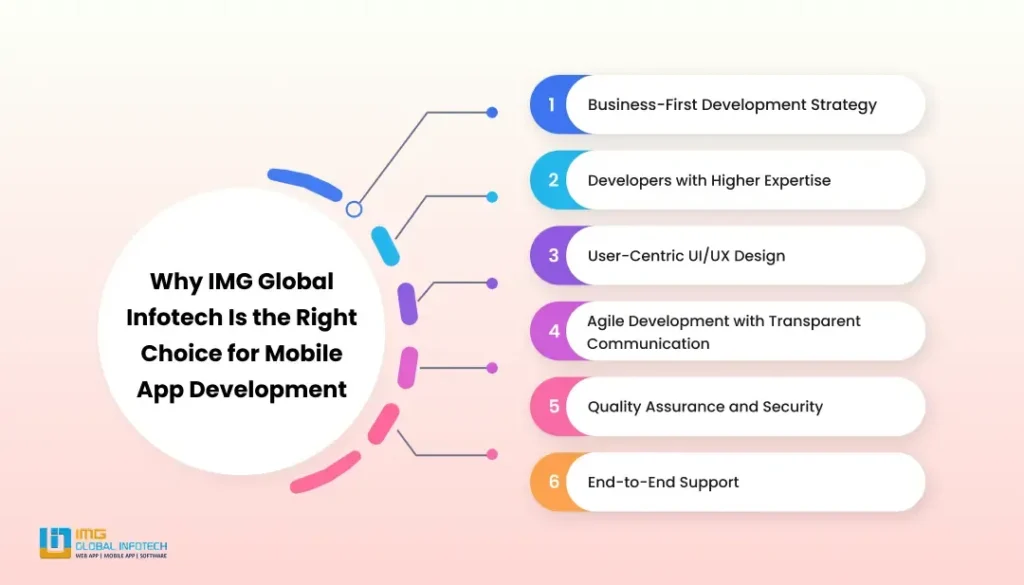
    Why IMG Global Infotech Is the Right Choice for Mobile App Development 

    Business-First Development Strategy

    Our team kicks off each engagement by figuring out what you actually want to achieve, who your target audience is, and what the market is expecting. Then we shape a strategic roadmap for building so your mobile app tackles real pain points, produces measurable results, and keeps backing long-term business growth with confidence.  

    Developers with Higher Expertise 

    You can hire mobile app developers india to work across Android, iOS, cross-platform stacks, AI, cloud systems, and newer emerging technologies. We blend hands-on technical skill with solid industry best practices, so every app stays scalable, secure, dependable, and prepared for future improvements—without the usual rewrites later on.

    User-Centric UI/UX Design

    Our specialists create intuitive, engaging, and good-looking mobile journeys that boost satisfaction and retention. We focus on smooth navigation, accessibility, and consistent user interactions. That way businesses can build apps people actually want to use, and yes, recommend to other folks too.

    Agile Development with Transparent Communication  

    We run Agile development in a way that leans on teamwork, ongoing feedback, and quicker iterations across the whole project journey. The team makes sure clients stay in the loop with steady progress notes, milestone check-ins, and plainspoken communication so there is real visibility from the initial planning stage right up to deployment.

    Quality Assurance and Security  

    Our QA specialists do extensive testing so each application keeps strong performance across different devices and operating systems from a leading mobile app development company in India. We also use sturdy security routines, spot weaknesses early, and tune reliability before your app lands in the market.

    End-to-End Support  

    Our commitment doesn’t stop at deployment—there’s maintenance, performance monitoring, additional features, and technical help afterwards. We assist companies as customer expectations shift, as operating systems get updated, and as market trends move, so their mobile app remains aligned and dependable.

    CTA

    Final Remarks

    Costing considerations when developing mobile apps in India involve a balance between several aspects, like choosing a platform, complexity of design, and local rates of labor.

    The developer community in India provides scalability, fast execution, and innovation at unbeatable rates in mobile app development company india, which is why it is the place to outsource mobile app development projects.

    No matter what kind of application you want to develop—from an MVP to a mobile platform for the whole world—a good scope of work and an appropriate Indian development team will help.

  • How to Build an Agentic Ecommerce Store with WooCommerce

    How to Build an Agentic Ecommerce Store with WooCommerce

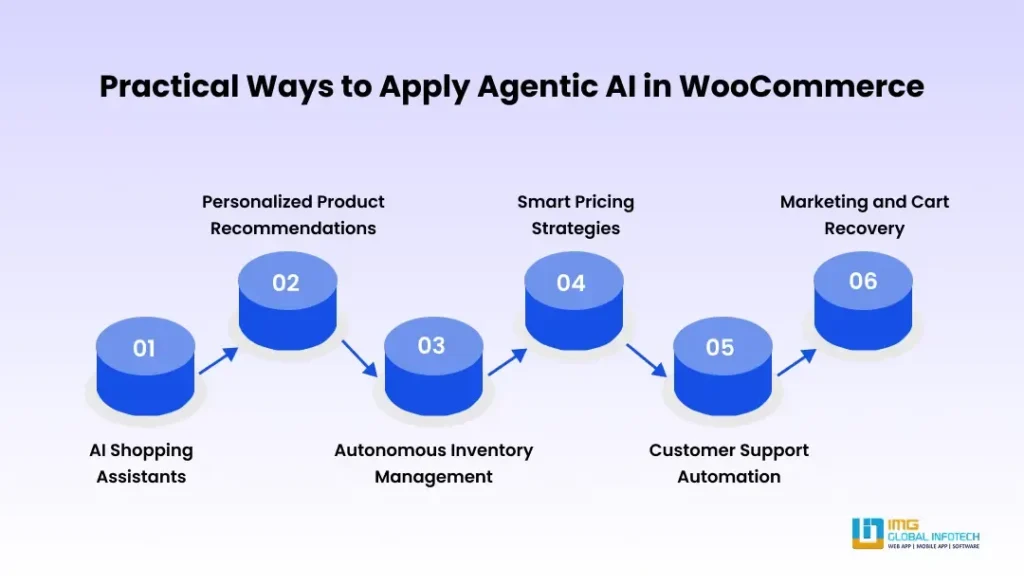
    Agentic Ecommerce is quickly becoming a hot topic in the WooCommerce world, and honestly, it’s not hard to see why. The way people shop keeps changing. AI isn’t just answering questions anymore—it’s out there browsing for products, weighing the pros and cons, and even pulling the trigger on purchases, all for the customer.

    If you run a WooCommerce store, this shift is a big deal. There’s a ton of potential if you get ahead and build your shop with AI shoppers in mind in custom woocommerce development​. Stores that catch on early can really stand out, while the ones that don’t might get lost in the shuffle as shopping gets more and more automated.

    Right now, AI is already researching products and making decisions for people in woocommerce development services. That’s a huge change, and it brings both exciting possibilities and some real hurdles for anyone selling online.

    What Is an Agentic Ecommerce 

    Agentic AI mainly refers to those AI systems that can autonomously plan, decide, and react according to defined goals with minimal human intervention. In e-commerce, agentic AI can also enable software to handle diverse tasks like pricing optimization, merchandising customer interactions, inventory control, and marketing execution without any constant supervision. It’s not like traditional automation tools or any scripted chatbots; agentic AI systems can operate continuously, can adapt to changing conditions, and can coordinate multiple actions across online stores. 

    Why WooCommerce Is the Right Platform for Agentic Ecommerce

    WooCommerce gives you that flexibility and scalability and also room for customization to craft smart ecommerce moments, kind of powered by AI agents from a woocommerce development company. The open source setup is pretty helpful too, because companies can run operations more automatically, shape the customer path more personally, and bring in advanced AI capabilities without all the heavy friction.

    Open-Source Flexibility

    With its open-source framework, WooCommerce lets you customize almost everything. Developers can design AI-driven workflows, automate everyday business actions, and shape agentic commerce experiences based on what each business really needs.

    Smooth AI Integration

    WooCommerce connects up nicely with AI APIs, automation tools, chatbots, and machine learning systems in custom WooCommerce development. That makes it easier to deliver more precise product suggestions, offer tailored interactions, and handle customer support automatically across the entire online store, even when things get busy.

    Scalable for Business Growth  

    Whether you’re kicking off a startup or moving an enterprise store into new markets, WooCommerce kinda scales in an efficient way thanks to plugins, cloud hosting, and optimized infrastructure. This helps handle rising traffic, more products, and AI-driven operations without too much hassle.

    Strong Plugin Ecosystem  

    There are thousands of WooCommerce plugins that make it easier to add AI capabilities, payment routes, inventory automation, analytics, and marketing features so businesses can build a smarter ecommerce platform that runs more smoothly. And it feels almost like you can piece it together step by step with less friction.

    How to Build an Agentic Ecommerce Store with WooCommerce? 

    Building an agentic ecommerce store with WooCommerce is kind of like blending AI-powered automation, smart workflows, and also those scalable e-commerce features all together in a WooCommerce development guide.  

    If you add AI agents into your store, you’re able to give shopping experiences that feel more personal, handle routine operations without as much friction, and generally push the business efficiency up, yeah

    Define the Business Goals

    First figure out what you actually want to achieve, who your target buyers are, and what parts you want to automate before development in agentic AI for ecommerce. That way your AI-driven e-commerce strategy stays lined up with your growth objectives, not randomly drifting  

    Set up the WooCommerce Store  

    Install WooCommerce on WordPress, then configure your products, payments, shipping, and security options so you get a solid base for these intelligent ecommerce operations.  

    Integrate AI Agents  

    Connect things like AI chatbots, product recommendation engines, and automation tools by using APIs or plugins. This is what lets you run personalized customer interactions and more capable business workflows, instead of just static pages. 

    Automate Store Operations

    Employ the use of AI for automating inventory management, order processing, pricing changes, and customer support to boost efficiency and eliminate repetitive processes.

    Optimize Customer Experience

    Leverage the power of AI for personalized services, predictive search, dynamic recommendations, and conversational shopping assistants that provide customers with an amazing shopping experience.

    Test, Monitor and Optimize

    Keep testing AI-driven processes, monitoring store operations, analyzing customer behavior, and optimizing integrations for efficient and secure agentic ecommerce operations.

    Core Technologies Behind an Agentic WooCommerce Store

    TechnologyPurpose
    WooCommerceEcommerce Platform
    WordPress Content Management System 
    Artificial Intelligence Decision Making 
    Large Language Models (LLMs)Natural Language Processing
    AI Agents Autonomous Task Execution
    WooCommerce REST APIData Integration
    Vector Database Semantic Search
    Automation Workflow Tools Process Automation
    Payment Gateway APIsSecure Transactions
    Cloud Infrastructure Hosting & Scalability 

    Cost to Build an Agentic WooCommerce Store 

    The average cost to build an agentic WooCommerce store would be $8,000 to $15,000 or more. The exact cost mainly depends on diverse factors and the level of the customization. 

    App Complexity Average Cost Time Duration 
    Basic Level $8,000 to $10,000 4 to 6 Weeks 
    Mid-Level $10,000 to $15,000 6 to 8 Weeks 
    Advanced Level $15,000+ 8 to 12 Weeks 

    Practical Agentic AI Use Cases for WooCommerce

    Here are some practical agentic AI use cases for WooCommerce. Let’s take a closer look at these agentic AI use cases: 

    AI Shopping Assistants

    Hyper-personalized recommendations are an example of a use case where the agency of AI proves to be highly crucial in the domain of woocommerce website development company. The AI shopping assistant makes recommendations based on factors such as location, weather, customer’s prior history, and current preferences.

    Personalized Product Recommendations

    Through agentic AI, you will have an opportunity to refresh your product catalog and maintain competitiveness due to analysis of suppliers’ feeds, social trends, and sales data. Being a component of smart catalog management for ecommerce, agentic AI adds new products, enhances descriptions based on feedback from customers, and deletes outdated items.

    Autonomous Inventory Management

    Using agentic artificial intelligence, one can predict demand, check inventory, and take into account the lead time of suppliers in order to automatically reorder popular products in a website development company.

    Smart Pricing Strategies

    The agent AI in the e-commerce industry will keep monitoring the prices of the competition, their demand trends, and the conversion effectiveness and will enable you to change your product prices within safe limits.

    Customer Support Automation

    An agentic AI is capable of dealing with common consumer questions and analyzing the tone and content of messages for indications of frustration in custom WooCommerce website development services. This system is able to automatically escalate problems to human agents or give a refund where appropriate.
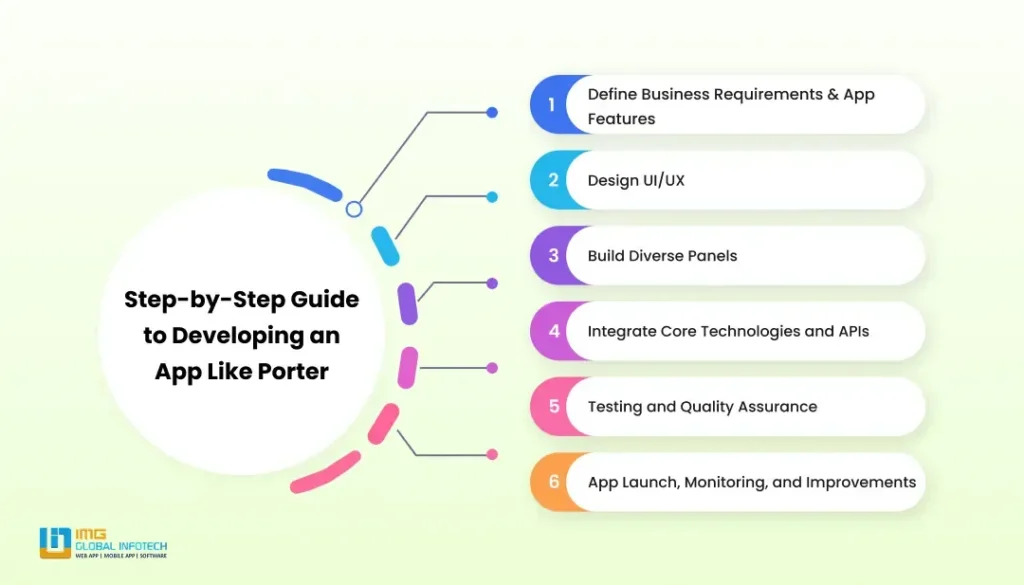
    Marketing and Cart Recovery

    Through its agentic abilities, an AI system can detect when a consumer drops off their cart and immediately initiate personalized follow-up campaigns via emails, texts, or even WhatsApp. The AI system can provide discounts or alternative products to the consumers and even join live chats if the consumer follows back.

    How to Measure the Success of Your Agentic Ecommerce Strategy? 

    Performance in agentic eCommerce is measured through KPIs that combine customer satisfaction, growth, and effectiveness of AI processes.

    Conversion Rate Optimization

    A high conversion rate confirms that individual customer journeys and AI-driven suggestions result in successful conversions in AI-powered ecommerce solutions from leads into customers, which positively impacts profit and growth.

    Increasing Order Value

    By measuring average order value (AOV), one can see how effective upselling, cross-selling, and bundling techniques in AI ecommerce automation have increased revenue and improved customer satisfaction.

    Customer Loyalty Building

    Assessment of customer lifetime value (CLV) guarantees that the company will benefit from loyalty programs, repeated purchases in WooCommerce AI integration, and retention strategies based on agentic AI workflows.

    Minimizing Cart Abandonment

    Measuring the cart abandonment rate helps find friction points in the purchase process and apply AI-driven nudge, reminder, and checkout solutions for recovering these lost sales.

    Improving Quality of Experiences

    High customer satisfaction scores prove personalized experience, responsive support, and AI integration for WooCommerce that improve trust and customer return.

    Efficiency of AI Workflows

    Evaluation of AI workflow efficiency proves that automation saves money, improves decision-making speed in AI agents for WooCommerce, and expands personalization possibilities.

    The Future of Agentic Ecommerce with WooCommerce 

    Agentic ecommerce is revolutionizing the world of online commerce by making possible intelligent decision-making, automation, and personalized customer experience through the use of AI agents from the best ecommerce website development company. Through the use of WooCommerce, businesses will be able to utilize the power of autonomous AI for their benefit.

    Personalized Shopping Using AI

    The use of AI agents will enable analysis of the customer’s preferences, browsing habits, and purchasing behavior to come up with personalized products for them. This will lead to greater satisfaction, customer engagement, repurchase, and loyalty to the brand name.
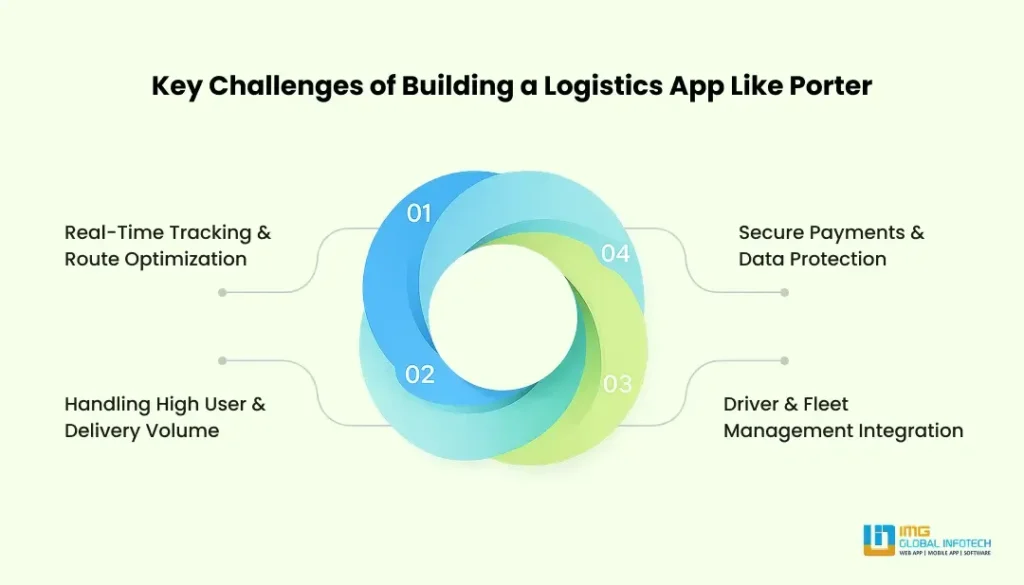
    Autonomous Store Management

    AI agents help to track inventory, adjust prices, process orders, and predict future stock levels. Using WooCommerce will make ecommerce management much easier for merchants and will help in focusing on growing their business.
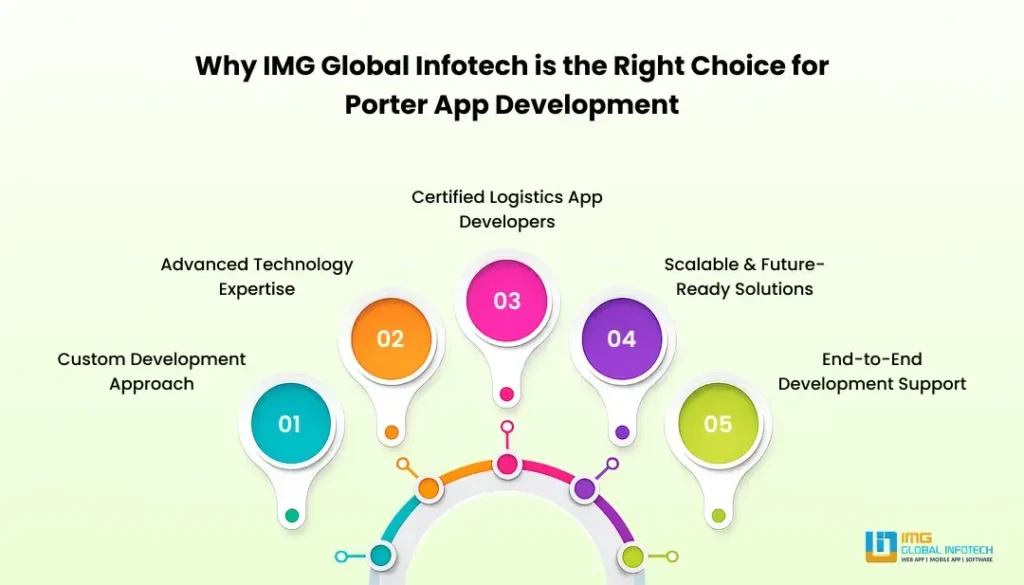
    Intelligent Customer Support

    AI-powered virtual assistants offer instant responses, address queries about orders, suggest products, and solve common problems in AI integration services. The WooCommerce companies get the advantage of 24/7 customer support, quick solutions, better user experience, and a higher customer retention rate.

    Data-Driven Business Growth

    The agentic AI continually evaluates the trends of sales, customer behavior, and market insights to give recommendations that work in AI ecommerce consulting. The WooCommerce company owners can make decisions about marketing strategy, products, and earning opportunities.

    Final Words

    This move towards agentic commerce for WooCommerce presents a huge advantage for innovative companies. A pivot to AI search readiness from regular SEO enables brands to own machine-lead transactions from high-intent users before anyone else in WordPress development services. Though, architecting your store for AI shopping assistance is no simple task. 

    In order to effectively achieve this, your store would necessitate customized data architectures, optimized APIs, and top-notch performance tweaks. 

    You do not have to venture out into this domain alone and, in the process, compromise on your existence. WPRiders acts as the preferred technical collaborator for businesses seeking to scale intelligently.

  • Build an App Like Porter: Step-by-Step Development Guide for Startups

    Build an App Like Porter: Step-by-Step Development Guide for Startups

    For crowded and densely populated urban areas, there will always be an increased requirement for logistics services. Logistics used to depend on making calls, local transportation services, coordination, and trust systems. 

    Delivery needs have evolved due to advancements in technology in on-demand logistics app development. People want real-time tracking. Even the small retailers require flexibility in transportation services as they cannot afford to own and manage vehicles of their own. 

    Through an application such as Porter, companies can easily book a mini truck, and drivers get job offers instantly. What the app does is that it just connects the dots. This is an innovative business model, which is why many companies today are showing interest in logistics app development.

    You require a robust back-end, real-time tracking, route optimization, driver management, a payment gateway—the list indeed goes on. In this guide, we’ll attempt to take you closer to achieving your goal through relevant information.

    What Is Porter and How Does It Work?

    Porter is a leading logistics app in India, which was established in 2014 and provides on-demand intercity goods transportation services. Basically, it acts as a tech-based aggregator that connects users with a wide fleet of vehicles, from two-wheelers, for quick, reliable, and clearly priced deliveries. 

    It can also enable booking for mini-trucks, tempos, and two-wheelers for moving goods within 22+ cities. It will also provide diverse vehicle options such as 2-wheelers, 3-wheelers, and different mini-trucks. 

    Key Features Required to Build an App Like Porter

    For the success of an App Like Porter, it is very important that it is developed with certain features in goods delivery app development. The success of developing an App Like Porter depends upon the choice of a good quality On-demand app development company for your existing business and logistics firm, respectively. Following are some features required for the success of the application.

    • Real-Time Vehicle Tracking: It can enable customers to track drivers & shipments live using GPS with estimated arrival times and route updates. 
    • Load & Unload Tracking: The users and drivers update the status of loading, pickup completion, unloading, and delivery milestones in real time in truck booking app development. 
    • Secure Payment Integration: It can support multiple payment methods to include UPI, credit/debit cards, digital wallets, net banking, and COD with automated invoicing. 
    • Shipping & Delivery Booking: It can allow users to book mini trucks, bikes, or delivery vehicles by entering pickup and drop-off locations for scheduling deliveries to select vehicle types. 
    • Real-Time Location Sharing: It can allow drivers to securely share the live location with customers, administrations, and recipients throughout the delivery journey. 

    Step-by-Step Process to Build an App Like Porter

    Creation of an application such as Porter requires adequate planning, an appropriate technology stack, and scalable architecture in logistics mobile app development. The adherence to a systematic development process helps in achieving better performance, seamless user experience, and sustained business growth.

    Step-by-Step Guide to Developing an App Like Porter

    Define Business Requirements & App Features 

    First, determine your target market, delivery approach, and business objectives. Then, finalize key features like user registration, vehicle booking, live tracking, payment gateway, driver management, notifications, and administration dashboard prior to development.

    Design UI/UX

    Create an intuitive user interface that makes the processes of booking, tracking, and payments easy. Develop wireframes and interactive prototypes to provide smooth navigation, quick access, and an exciting experience to users, drivers, and administrators.

    Build Diverse Panels 

    Create individual applications or modules for users, drivers, and administrators that show how to build an app like porter. Each panel needs to have features specific to the respective role, such as booking management, order tracking, earnings dashboard, analytics, notifications, and control mechanisms.

    Integrate Core Technologies and APIs

    Incorporate GPS tracking, route optimization, payment gateways, push notification, cloud storage, and communication APIs into your app. Integrating such technologies will increase the efficiency and effectiveness of the deliveries made as well as user and driver interactions.

    Testing and Quality Assurance

    Carry out thorough testing for the functions, security, speed, usability, and compatibility of the app in order to make sure that there are no problems with its operations.

    App Launch, Monitoring, and Improvements

    Publish your logistics app on the Android and iOS platforms as well as online, if possible. Regularly monitor the users’ actions and update your application accordingly.

    Challenges in Developing a Logistics App Like Porter

    When you build a logistics app that looks like Porter, you end up juggling real-time operations, smooth communication, and kind of fast delivery management all at once. At the same time, you still need to beat the technical plus operational hurdles, so the end result becomes dependable, scalable, and easy for regular users to handle.

    Key Challenges of Building a Logistics App Like Porter

    Real-Time Tracking & Route Optimization

    Getting accurate GPS tracking with smart route optimization can be weirdly tricky. Developers have to keep live location updates flowing, make navigation aware of traffic conditions, and also limit battery drain while the app stays steady and responsive.

    Handling High User & Delivery Volume

    A logistics app is expected to manage thousands of simultaneous users, delivery requests, and driver activity together. That means scalable architecture and cloud infrastructure are not optional if you want consistent speed, solid stability, and no random service hiccups.

    Driver & Fleet Management Integration

    Coordinating driver onboarding, their availability, vehicle monitoring, and delivery assignments needs tight backend integration. When fleet management works properly, dispatch becomes faster, productivity tends to rise, and customer satisfaction feels more consistent.  

    Secure Payments & Data Protection

    Using secure payment gateways, encrypted transactions, and strong data protection controls is essential in custom logistics app development. Developers must protect customer information flow without breaking the checkout flow and while meeting the relevant security requirements for compliance.

    How Much Does It Cost to Build an App Like Porter?

    The average cost to develop an app like Porter would be $5,000 to $15,000 or more. The exact cost would be finalized on diverse factors and the customization to determine the porter app development cost. 

    App Complexity Average Cost Time Duration 
    Basic Level $5,000 to $8,000 4 to 5 Weeks 
    Mid-Level $10,000 to $15,000 5 to 8 Weeks 
    Advanced Level $15,000+ 8 to 12 Weeks 

    Why Choose IMG Global Infotech for Porter App Development?

    Selecting the right logistics app development company is very important to build an app like Porter. With the proper expertise, our experts can build a scalable and feature-rich user-friendly platform that can support long-term growth in the business via truck booking app development services. Here are some reasons why you should choose IMG Global Infotech for the porter app development: 

    Why Choose IMG Global Infotech for Porter App Development?

    Custom Development Approach

    We can understand every logistics business with unique requirements, so our developers can build customized, Porter-like applications with suitable features. It also includes flexible workflows and business-focused solutions that can meet your business goals. 

    Advanced Technology Expertise

    You can hire logistics app developers to utilize the modern technologies for secure frameworks with cloud infrastructure and API integrations. It can help to develop high-performance logistics applications that can deliver security, reliability, speed, and extensive scalability. 

    Certified Logistics App Developers

    Our team has comprehensive experience developing logistics and on-demand delivery apps. It majorly includes advanced features that can ensure smooth operations for a seamless user experience for scalable architecture in your business. 

    Scalable & Future-Ready Solutions

    We develop logistics applications that are prepared for the future and capable of adjusting themselves to meet the rising number of users, changing business models, latest technology trends, and customers’ expectations.

    End-to-End Development Support

    From conception to launch—project plan creation, UI/UX design, implementation, testing, deployment, and maintenance—we offer end-to-end development to run your logistics application optimally in multi-vehicle logistics app development.

    need-a-feature-rich-porter-like-delivery-app

    Final Thoughts

    The potential within the on-demand logistics sector is phenomenal, and the key to capitalizing on it will be a strong, scalable, intuitive technology solution that can handle your customers’ needs and driver operations seamlessly. 

    Building your own custom technology solution may sound enticing, but consider the massive financial, time, and resource investment required against the ability to jumpstart your operation with a pre-built, deployable, and proven technology by a leading on-demand logistics app development company in your business. 

    To stand apart from the crowd, you need to focus on branding and operations—not the highly specialized and difficult work of technology development.

  • How to Build a Telemedicine App from Scratch (Step-by-Step)

    How to Build a Telemedicine App from Scratch (Step-by-Step)

    Currently there are over 350,000 health applications in existence, and 82% of hospitals and clinics use telemedicine platforms. The industry has plenty of opportunities and customers that are looking for healthcare anytime, anywhere without any limitations of location and working time.

    It would be made possible by telemedicine apps, but creating a telemedicine app that is both secure, efficient, and user-friendly is not an easy job.

    With growing demands from patients to access healthcare and problems faced by healthcare systems due to high expenses and inefficiency of operations, telemedicine becomes the solution for these issues.

    In this blog, we will demonstrate the development process to build a telemedicine app from scratch. We will also talk about the costs, features, and technologies needed for the creation of such a telemedicine app.

    Market Overview & Business Case

    As per the report of Grand View Research, the global telemedicine market size was valued at $130.5 billion in 2025 and is projected to grow from $157.9 billion in 2026 to $514.2 billion by 2033, at a CAGR of 18.4% from 2026 to 2033.

    Key Market Trends & Insights:

    • By Modality: The real-time segment led the market with the largest revenue share of 38.2% in 2025. 
    • By Facility: Tele-home segment led the market with the largest revenue share of 50.3% in 2025. 
    • Delivery Mode: Web/mobile segment led the market with the largest revenue share of 79.0% in 2025. ‘
    • By Component: Product segment led the market with the largest revenue share of 51.2% in 2025. 
    • By Application: The telepathology segment led the market with the largest revenue share of 20.5% in 2025.

    What are the Different Types of Telemedicine Apps?

    Telemedicine applications are available in various forms, depending on the needs of both the patients and the health care professionals in telemedicine app development. All these types have their own unique attributes that make them more accessible and convenient.

    Popular Types of Telemedicine Apps Transforming Healthcare

    On-Demand Consultation Apps

    On-demand consultation apps are basically for connecting patients with doctors right away, like through video, voice, or even plain chat. They tend to work well when something is urgent medically, when someone needs rapid guidance.

    Scheduled Appointment Apps

    Scheduled appointment apps are more about booking consultations ahead of time, at dates and hours the patient picks in the telemedicine app development process. These apps make clinic operations easier, cut down on how long people wait, and keep virtual healthcare delivery more organized for routine consultations.  

    Hybrid Telemedicine Platforms

    Hybrid telemedicine platforms kind of blend both worlds. You get instant consultations and also scheduled appointment options, so patients and providers have more room to maneuver.

    CTA

    Must-Have Features of a Telemedicine App

    To build a reliable telemedicine app, it is important to integrate core features of telemedicine app that can meet the diverse needs of patients and doctors through a single platform. 

    Appointment Scheduling 

    An easy-to-use system must be developed, which will let the patients book an online consultation with the doctors depending upon their specialization and availability.

    Secure Messaging System 

    It can enable secure texting between patients and healthcare professionals for non-emergency questions, general contact, and follow-ups. It can also ensure that the messaging function will also adhere to the healthcare privacy rules. 

    Telehealth Monitoring 

    It majorly includes the capabilities that can check vital signs & health measures remotely. This process is especially important for patients with chronic diseases, who may need continuous care. 

    AI-Powered Symptom Checker 

    The integration of an AI-powered symptom checker can help people analyze their health issues before taking any professional guidance. This feature can provide patients some early assistance to help them to make informed decisions regarding their health journey. 

    Multilingual Support 

    This feature can help the system to recognize the different language needs of your users to support the several languages. This feature also provide assurance that language hurdles do not limit the access to healthcare services

    Health Record Management 

    This could enable them to view their EHR, which comprises their medical history, plans, and test results. It will also help in making sure that health records are securely stored and shared with health experts.

    Step-by-Step Process to Build a Telemedicine App

    Now let us talk about the stages of developing a telemedicine application for ensuring its reliability and security. The following step-by-step instruction is for developing a custom telemedicine app as well:

    Telemedicine App Development Process Explained 

    Define Business Goals and Target Audience

    Identify the objective of your app, the target audience, the type of health care facilities, and the requirements of the market in order to establish a definite development strategy for your telemedicine app.

    Plan Core Features and Functionalities

    Combine video consultations, scheduling, profiles, prescriptions, secure messaging, payment and health record management functionalities into your application so that you can offer impeccable healthcare services through your telemedicine portal.

    Design an Intuitive UI/UX

    Create a user-friendly and intuitive UI/UX design for easy navigation and access on all types of screen sizes for a better experience for patients and doctors in the telemedicine app development guide.

    Develop a Reliable Backend

    Develop a robust backend based on secure APIs, cloud infrastructure, encrypted databases, and scalable architecture to provide efficient support for the growing healthcare business.

    Testing & Quality Assurance

    Adopt healthcare compliance requirements and conduct security analysis, usability testing, performance testing, and bug fixes to launch your telemedicine application.

    Deployment & Post-Launch Support

    Deploy your application, monitor performance, fix errors, update the software regularly, and implement new features in on-demand doctor app development.

    Tech Stack for Telemedicine App Development

    Here is the tech stack for telemedicine app: 

    Development Component Recommended Technology Stack
    Frontend (Android & iOS) Flutter/React Native 
    Web Frontend React.js & Angular 
    Backend Node.js, Django, and Laravel 
    Database  PostgreSQL & Mongo DB 
    API Communication REST API & GraphQL 
    Video Consultations WebRTC, Twilio, and Agora 
    Authentication & Security OAuth 2.0,  JWT, and MFA
    Cloud Hosting AWS, GCP, and MS Azure 
    Payment Gateway Stripe, Razorpay, and PayPal 
    Push Notifications FCM & APNs

    Cost to Build a Telemedicine App

    The average cost to develop a telemedicine app would be $5,000 to $15,000 or more. The exact cost would be finalized on several factors and the level of the customization in telemedicine app development. 

    App Complexity Average Cost Time Duration 
    Basic Level $5,000 to $8,000 4 to 5 Weeks 
    Mid-Level $10,000 to $15,000 5 to 8 Weeks 
    Advanced Level $15,000+ 8 to 12 Weeks 

    Why Choose IMG Global Infotech for Telemedicine App Development

    Building a secure, scalable, and feature-rich telemedicine app really takes technical know-how plus deep industry knowledge to telemedicine app development like Practo. We blend emerging tech with healthcare-oriented development practices so you get dependable digital healthcare solutions that match what your business is trying to do, not just “something that works.”

    Healthcare-Focused Development Expertise  

    Our team has a lot of hands-on experience making telemedicine platforms with secure video consultations, appointment organizing, e-prescription workflows, and patient management tools while also watching compliance, usability, and that smooth digital healthcare feel across multiple devices and operating systems.  

    Custom Telemedicine Solutions  

    Our developers craft a fully customized telemedicine application around your care processes, business aims, and patient needs to build a telemedicine app development like Teladoc. In other words, every capability lines up with how your organization actually runs, and it still stays ready for future growth and scale.  

    Secure & Compliance-Ready Applications  

    We take patient data protection seriously, using strong encryption, secure sign-in methods, and role-based access controls, plus healthcare compliance requirements in the telemedicine app development timeline. This helps organizations safeguard sensitive medical information, build real user trust, and keep platform reliability steady over time.

    Advanced Technology Integration  

    We bring together our specialists and AI-powered chatbot solutions, remote patient monitoring, wearable gadget connectivity, electronic health records, cloud infrastructure, and secure payment systems to build modern telemedicine platforms that feel smoother and have more functionality for the end-user experience. 

    End-to-End Development & Continued Support  

    We handle basically every step, from strategy and UI/UX design to deployment, testing, upkeep, feature upgrades, and technical support, so once you launch, your telemedicine platform stays secure, modern, and performance-driven.  

    Scalable Solutions for Future Scalability 

    Our developers craft scalable telemedicine applications using flexible architectures that can absorb growth in patient count, extend healthcare services, connect with third-party tools, and adapt to shifting business needs, all while protecting performance, security, and user experience.

    CTA

    Closing Statement

    This detailed guide sort of gives a view into the process of how to build a doctor consultation app from scratch. But honestly, just creating it and working on the framework, it isn’t enough. 

    Because any healthcare application, if it wants to be viable in the healthcare space, has to be highly compliant with the governing laws that are currently in place from a leading telemedicine app development company for startups

    Meeting regulatory requirements and data privacy rules is crucial for the success of a telemedicine app. When you make sure patient safety and privacy are handled properly, you can build trust with patients and healthcare providers, and in the end you help the app become a dependable platform for remote care services.

  • Shopify vs Custom eCommerce Development: A Complete Comparison Guide

    Shopify vs Custom eCommerce Development: A Complete Comparison Guide

    Choosing between Shopify and an independent website is one of the most critical decisions in developing a business. A wrong decision can create severe financial losses for the business both in the short and long term. In addition, the selected option may fail to meet the company’s requirements in a few years.

    As an established ecommerce development company that builds websites, they understand the nuances of the decision and offer their insight on the matter in Shopify vs Custom eCommerce Development. It also believes that neither Shopify is inherently better than a personalized ecommerce solution nor custom coding is superior to using an application marketplace. 

    Below, you will see the primary differences between Shopify and custom ecommerce development that will help you decide which one is a better fit for your business.

    What Is Shopify and How Does It Work?

    Shopify is a subscription-based ecommerce platform that helps businesses build, manage, and grow online stores without requiring advanced technical skills or a collection of separate tools.

    Instead of piecing together hosting, website builders, payment processing, security, and analytics from different providers, Shopify brings everything together in one easy-to-use platform. 

    With all the essential tools in a single dashboard, business owners can spend less time managing technology and more time selling products, marketing their business, and growing their brand.

    What Is Custom eCommerce Development?

    Custom ecommerce development is the process of building an online store from the ground up to meet a business’s specific needs and goals.

    Rather than relying on a standard platform with pre-built templates and features, it gives developers the flexibility to create a store with custom functionality, unique designs, and tailored user experiences in Custom ecommerce development. 

    This makes it easier to support specialized product catalogs, unique customer journeys, and business processes that off-the-shelf ecommerce platforms may not be able to handle.

    What Are the Key Differences Between Shopify and Custom eCommerce?

    Here are some major key differences between Shopify and custom ecommerce development: 

    Factor Shopify Custom Development 
    Time to launch Days to a few weeks Three to six months or more 
    Upfront cost Low (plan plus theme) Higher (scoped, one-time build) 
    Ongoing cost model Subscription, apps, and transaction fees Hosting & maintenance control
    Customization ceiling Medium (themes & apps) Unlimited (own codebase)
    ScalabilityStrong for standard retail Engineered to your exact load
    Integration Wide app store, limited deep logic Any systems, built to fit your workflows 
    SEO & Content Good, with URL and content constraintsFull control of structure and content 
    Data OwnershipBound by platform policies Full ownership of code & data 

    Shopify vs Custom Ecommerce in Terms of Cost

    Mostly businesses look only at the setup cost, Total Cost of Ownership (TCO), to define a different story in Shopify vs Custom eCommerce development. 

    Shopify TCO: The cost basically divides in several segments. Lower upfront cost + monthly platform fees + monthly app fees + transaction fees on every sale. Over the years, a successful store can pay thousands in returns on investment. 

    Custom TCO: The cost majorly depends on different factors. Larger upfront investment + Cheap hosting costs + Maintenance. As soon as the code has been developed, it belongs to you. So when your sales grow tenfold, your costs stay exactly the same. 

    Custom development gets a lot cheaper than its shelfware cousins if you are serious about volume.

    Platform Complexity Shopify Custom EcommerceTime Duration 
    Basic Level $5,000 to $8,000 $8,000 to $10,0004 to 5 Weeks 
    Mid-Level $8,000 to $10,000 $10,000 to $15,0005 to 8 Weeks 
    Advanced Level $15,000+ $15,000+8 to 12 Weeks 

    Which Businesses Should Choose Shopify or Custom Development?

    For any type of business that requires rapid, dependable ecommerce capabilities, a Shopify store is ideal. A custom development is the ideal choice for companies with advanced functional requirements and full flexibility. Businesses in the following categories often make these choices:

    Startups and New Ecommerce Business

    Shopify really fits startups that are trying to get an online store live fast, with little technical work, plus hosting already there and a bundle of core ecommerce pieces.  

    Small & Medium Businesses (SMBs)  

    SMBs who want something reasonably priced and not hard to run can lean on Shopify development services, its app ecosystem, and the secure checkout and payment options.  

    D2C Brands 

    D2C brands that plan to expand later on can use Shopify’s automation tools, multichannel selling features, and marketing tie-ins so growth happens in Shopify development in a more organized way.

    Large Enterprises  

    For big companies with complex business operations, advanced workflows, and custom integrations, a tailored ecommerce setup is often required, one that is built around their actual needs rather than a one-size-fits-all plan.

    B2B Businesses  

    Organizations that do wholesale and bulk ordering, along with custom pricing or dealer portals, usually gain more from ecommerce website development services. This helps cover sector-specific requirements and keeps workflows flexible even as things change.

    Well-Establish Brands 

    If a brand wants personalized shopping journeys, special features, or highly interactive interfaces, then they should go with custom development. That way they get full flexibility and full control over what customers see and how they move through the process.

    How Do You Choose the Right eCommerce Platform for Long-Term Growth?

    Here are the most vital factors while choosing the right eCommerce platform before committing to a solution: 

    Technical Partner Experience

    You need to look for proven experience with major e-commerce platforms (Shopify, Magento, and WooCommerce) and custom builds. You need to also examine their past projects to understand their workflow and project understanding. 

    Developer Support and Documentation

    The expertise of a developer mainly depends on different factors. It mainly includes comprehensive APIs, developer sandboxes, and clear documentation that can reduce development time. The dedicated technical support team can also accelerate the troubleshooting of errors in the development process. 

    Customization & Scalability

    Scalability is important to support growth in diverse elements and platforms. It includes multi-store setups, new product lines, and high traffic volumes without any integration of frequent re-architecture in business operations. 

    SEO & Performance Optimization

    It is important to implement clean URLs with schema markup and fast load speeds to maintain CDN support, which is very critical to examine the Cost to build custom ecommerce development. The custom platform should also offer a built-in optimization feature that can allow easy integrations in the development process. 

    API Flexibility in Mobile Responsiveness

    Mobile-first performance isn’t a compromise in any condition, so you can Hire ecommerce developers for this situation. Choose the platforms with scalable tech support like REST/GraphQL APIs that can allow smoother frontend and seamless PWA development. 

    Why Choose IMG Global Infotech for Ecommerce Solutions?

    Our team can build innovative solutions that can cater to all your business needs and requirements. Our team will also ensure seamless development with the integration of advanced features and long-term support for scalable online success in your business. Here are some major reasons to select IMG Global Infotech to develop a reliable ecommerce platform. 

    Customized Solutions

    Our team is ready to develop the best customized solutions for your business. Our experts are always looking for the most relevant technologies to build an outstanding e-commerce platform tailored to your requirements.

    Expert Developers

    Our expert developers are always trying to create secure and highly productive e-commerce platforms from our ecommerce development company in Jaipur. Our professionals know the latest technologies and trends, allowing them to create solutions matching your business processes, goals, and customer needs.

    Innovative Technologies

    Our developers are constantly exploring innovative ways to improve the performance of an e-commerce website or online store. Using their expertise, they can implement powerful features and functions that allow your business to meet the highest standards in the industry.

    Integration Solutions

    We provide the best integration services for your e-commerce platform. Our team has the required experience and knowledge to make the best solutions for your business. We can introduce you to the best CRM and ERP software that will optimize your business processes. 

    High-Quality Support

    The mainstay of our work is the high-quality support and maintenance services we provide. Our experts will develop a solution for the stable and safe functioning of your e-commerce platform. 

    We will help you find the best ways to optimize the performance and security of your business. Our professionals are always available to respond to any problems and questions.

    Wide Range of Opportunities

    The ecommerce platform developed by our experts provides you with a wide range of opportunities. In the future, you will be able to expand the functionality of the developed solution and scale your business.

    Closing Remarks 

    Shopify is a good platform for many growing retail businesses, but it isn’t the right fit for everyone in the long run from top custom ecommerce development companies. As your operations get more complex, costs can rise, and flexibility becomes crucial. At that point, a standard platform might slow down your growth. 

    The best choice depends on your business goals, operational needs, and long-term vision. 

    We hope this guide has helped you see when Shopify is a good option and when custom ecommerce development is the better long-term investment.